South Africa Justifies BRICS Naval Drills as ‘Essential’ Amid Tensions
South Africa Justifies BRICS Naval Drills as ‘Essential’ Amid Tensions
South Africa has officially defended its hosting of the “Will for Peace 2026” naval exercises, describing the drills as “essential” for maritime security.
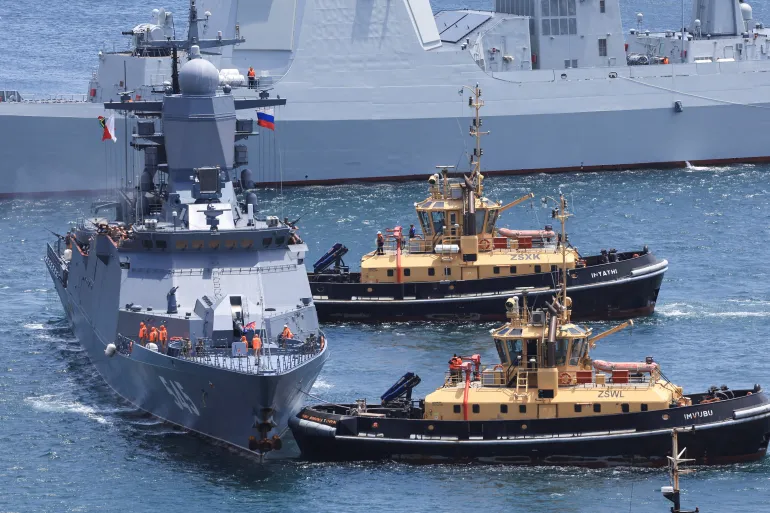
The weeklong maneuvers, taking place off the coast of Cape Town, involve a coalition of BRICS Plus nations including Russia, China, Iran, and the United Arab Emirates. South African military officials emphasized that the collaboration is a vital response to rising global maritime tensions and a necessary step toward protecting international shipping lanes and economic interests.
The exercises feature a significant display of naval power, with China and Iran deploying destroyer warships while Russia and the UAE dispatched corvettes to join a South African frigate. Other BRICS members and partners, such as Brazil, Indonesia, and Ethiopia, are participating as observers. Captain Nndwakhulu Thomas Thamaha, the joint task force commander, stated during the opening ceremony that the drills represent a “statement of intent” and a demonstration of collective resolve among the expanded bloc to cooperate in an increasingly complex global environment.
The timing of the drills has drawn international scrutiny, as they coincide with a period of extreme friction between the United States and several BRICS members.
The exercises began just days after the U.S. military seized a Venezuela-linked Russian oil tanker and following the abduction of Venezuelan President Nicolás Maduro. Under the current U.S. administration, Washington has characterized the BRICS bloc’s policies as “anti-American” and has threatened to impose a 10-percent tariff on member states in addition to existing trade duties.
Despite pressure from Washington, South African Deputy Defence Minister Bantu Holomisa insisted that the drills were planned long ago and are not intended as a provocation.
He urged external critics not to “press panic buttons,” clarifying that while the United States may have adversarial relationships with certain nations, South Africa does not view those countries as enemies.
Holomisa emphasized that South Africa’s priority remains the safety and cooperation of the Indian and Atlantic Oceans through its established partnerships.
This military cooperation further highlights the growing rift between Pretoria and Washington. South Africa has already faced U.S. criticism for its refusal to condemn Russia’s actions in Ukraine and for its legal challenge against Israel at the International Court of Justice. By proceeding with these high-profile naval exercises, South Africa and its BRICS partners are signaling a commitment to a multipolar world order and the exercise of sovereign foreign policy independent of Western influence.