Rivers Assembly Begins Third Impeachment Proceedings Against Fubara
Rivers Assembly Begins Third Impeachment Proceedings Against Fubara
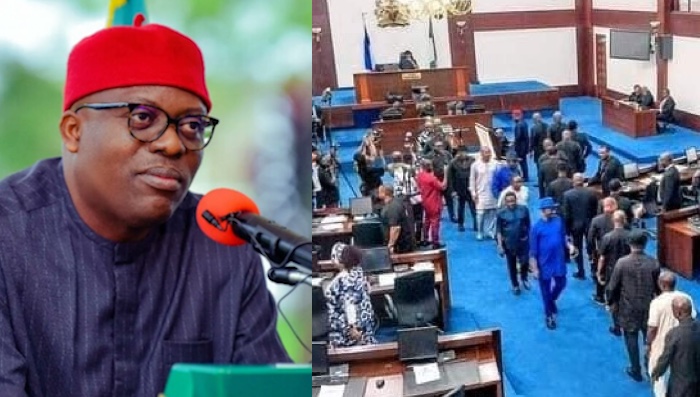
Rivers State House of Assembly officially commenced fresh impeachment proceedings against Governor Siminalayi Fubara and his deputy, Professor Ngozi Odu, on January 8, 2026. This move marks the third attempt to remove the governor since he took office in 2023, signaling a total collapse of previous peace agreements.
The lawmakers, led by Speaker Martins Amaewhule, have effectively halted the state’s governance cycle by barring the governor from presenting the 2026 Appropriation Bill until the conclusion of their investigation.
The allegations leveled against the governor center on claims of gross misconduct and financial recklessness.
Specifically, the Assembly accused Fubara of failing to submit the Mid-Term Expenditure Framework (MTEF) as required by law and spending public funds without legislative appropriation.
During a televised plenary session, the lawmakers argued that these actions constitute a grave violation of constitutional provisions and an intentional effort to undermine the authority of the legislative arm of government.
This latest move is widely seen as a continuation of the bitter feud between Governor Fubara and his predecessor, the current Minister of the Federal Capital Territory, Nyesom Wike.
Despite multiple interventions by President Bola Tinubu in 2023 and 2025, the tension between the two camps remains unresolved.
The lawmakers, most of whom recently defected from the PDP to the APC, claimed the governor has shown “recalcitrant disobedience” toward the president’s peace resolutions, leaving them with no choice but to pursue constitutional removal.
The announcement has met with immediate internal resistance from within the governor’s new party.
The Rivers State APC Publicity Secretary, Darlington Nwauju, issued a statement rejecting the impeachment process and urging the lawmakers to desist from actions that could drag the party’s image into the mud.
Nwauju argued that because a budget was already approved during the 2025 state of emergency, the governor is within his rights to operate within that framework, and he characterized the impeachment move as a “fratricidal disagreement” that serves no public interest.
Civil society organizations and ethnic interest groups have also raised the alarms over the potential for violence and instability.
Groups such as the Human Rights Writers Association of Nigeria (HURIWA) and the Campaign for Democracy (CD) have called on President Tinubu to urgently “rein in” Nyesom Wike, whom they accuse of orchestrating a proxy war against the sitting governor.
Similarly, the Ijaw National Congress (INC) and Ijaw Youth Council (IYC) warned that the move is an affront to the sovereign will of the electorate and could lead to a breakdown of law and order.
As the state enters this new period of uncertainty, the legal and political future of the Fubara administration remains precarious. While the Speaker of the Assembly insists that the process is a “corrective measure” to protect the constitution, critics view it as a desperate political maneuver to assert control over the state’s resources.
With the judiciary expected to be drawn into the fray once again, the people of Rivers State face the prospect of further governance delays and heightened social tension in the coming weeks.