


ADC: The Gathering of People Without Existential, Humanistic Ideology
By Bamidele Atoyebi
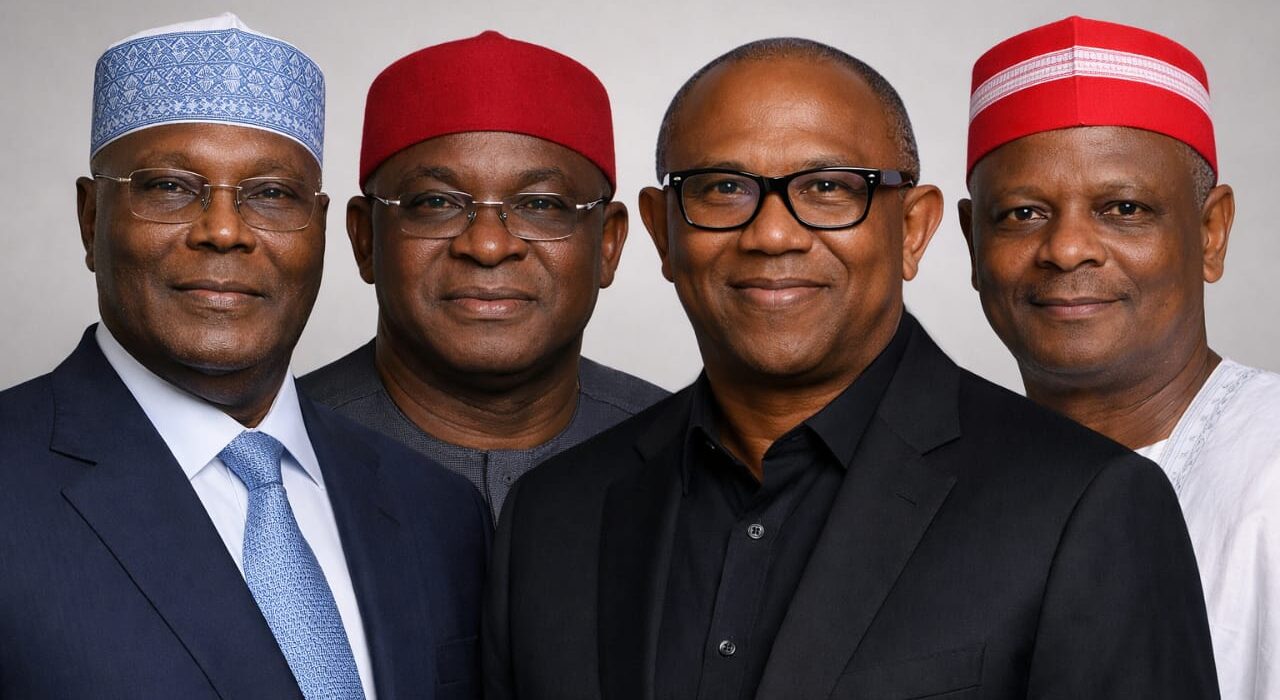
The Nigerian political landscape is currently undergoing a turbulent transformation as the African Democratic Congress (ADC) becomes the latest rallying point for veteran politicians. This “gathering” of figures like Atiku Abubakar, David Mark, and Rabiu Kwankwaso raises fundamental questions about the nature of political structures in the country.
Critics argue that a true political party cannot be built on a “humanistic vacuum” where personal ambition supersedes a coherent ideology. For a party to survive beyond an election cycle, it requires a foundation of shared values rather than a temporary marriage of convenience aimed solely at seizing the presidency.
Building a political party is a “serious business” that demands deep-seated dedication and a willingness to be “sold out” to a collective mission. However, there is a growing concern that some elite figures view these institutions as platforms to be hijacked or purchased cheaply. This “shortcut” approach to power ignores the grit required to build a structure from the ground up. When leaders feel entitled to a party’s mandate without having invested in its growth, they risk undermining the very democracy they seek to lead, treating political platforms as disposable vehicles rather than lasting institutions.
A primary target of this critique is Atiku Abubakar, whose political career is often viewed through the lens of perceived entitlement. As a former Vice President with significant wealth, there is a lingering narrative that he expects power to gravitate toward him naturally. However, his electoral history suggests a disconnect with the voting public, including within his own Northern base. Historically, Atiku has struggled to secure a monolithic Northern mandate when faced with candidates like the late Yar’Adua or Muhammadu Buhari. This suggests that voters prioritize leadership qualities and developmental track records over regional or ethnic identity.
Furthermore, Atiku’s ideological consistency is frequently called into question by his detractors. During his tenure as Vice President, his primary association was with the privatization of national assets a move many viewed as selling off Nigeria’s infrastructure rather than expanding it. This “liquidation” approach to governance creates a fear that his leadership would prioritize the auctioning of state resources over sustainable development. Without a clear personal or party ideology, his frequent transitions from one platform to another, including his time in Dubai between election cycles, are seen as signs of a leader disconnected from the daily struggles of the Nigerian people.
On the other hand, Peter Obi’s meteoric rise is being re-examined through a more critical lens. While he positioned himself as a “Third Force” during the 2023 elections, his record as the Governor of Anambra State remains a subject of intense debate. His tenure was marked by significant industrial unrest, with strikes paralyzing the health and education sectors essential pillars of any functioning society. While he frequently speaks of “saving” government funds, critics point out that investing state money into a bank where he held personal interests raises serious questions about ethical governance and whether his priorities truly lay with the public interest.
The most harrowing aspect of Obi’s gubernatorial record often cited is the Ezu River massacre of 2012/2013, where dozens of bodies were discovered floating in the river. The perceived lack of executive accountability for such a significant security and humanitarian failure remains a deep-seated stain on his leadership profile. His critics argue that his current national prominence is less about a proven track record and more about an opportunistic capitalization on public dissatisfaction. By leaning into sensitive religious and regional sentiments, he is accused of manipulating those with limited political knowledge and planting seeds of discord rather than fostering national unity.
Critics argue that many infrastructure projects, particularly road under Obi when he was Anambra governor were handled by unqualified, substandard contractors to save costs. Consequently, these roads often deteriorated within months, requiring expensive reconstructions by his successors and raising questions about the sustainability of his methods.
Another point of contention in Obi’s legacy is the delay in essential infrastructure, such as a functional airport for Anambra State. Despite his tenure, the airport project was not realized until his successor, Willie Obiano, took office. This gap in development serves as a reminder that popular political figures often leave behind unfinished or unaddressed foundational needs.
Obi ‘s Failure to Conduct Local Government Elections for most of his eight-year tenure, preferring to operate with appointed transition committees rather than elected council officials is a shameful act that stand against what true democracy is. Despite his reputation for fiscal responsibility, the poverty rate in Anambra was not significantly reduced and in some estimations, was higher than before his tenure.
In the 2023 election cycle, Obi is further accused of strategic manipulation regarding the APC’s Muslim-Muslim ticket. Critics argue that instead of presenting a superior governance framework, he chose to capitalize on the religious sensitivities of the Christian community to sow division. By positioning himself as a sectarian alternative, he was seen as weaponizing faith to bridge his own lack of a national political structure. This tactical shift is viewed by many as a dangerous precedent that prioritizes short-term electoral gains over the long-term social cohesion of a multi-faith nation like Nigeria.
David Mark, a prominent figure in Nigerian politics and an influential figure in ADC served as Senate President for eight, yet critics point to a stark lack of tangible progress in his home state of Benue. Essential roads leading to Otukpo remained in disrepair throughout his time in office, with no significant contracts awarded for their improvement. This perceived negligence suggests that high-ranking federal positions do not always translate into local development. It worthy of note that Mark also abandoned PDP that made him senate president and elected him as senator for 16years
Furthermore, the escalating insecurity in Benue State is often cited as a significant failure of leadership during Mark’s era. There was a noted absence of strategic facilitation for security equipment, barracks, or police stations that could have mitigated the crisis affecting his people. While he held one of the highest offices in the land, there is a perceived lack of progressive bills or reasonable government projects facilitated for his immediate community.
Like Atiku, Obi’s history of party-hopping from APGA to PDP, then to the Labour Party, and now potentially toward the ADC suggests a lack of personal investment in political institutions. This “scorched earth” approach to party membership often leaves organizations fractured once he departs. A political leader who does not build or sustain a party from the ground up risks being viewed as a tenant rather than an architect. This stands in stark contrast to the effort required to manage internal party disputes, such as the hundreds of court cases the APC has navigated internally to maintain its structural integrity and achieve a sense of internal success.
The current administration under President Bola Tinubu is often presented as the counter-narrative to this perceived lack of responsibility. Supporters point to his history of building the APC from a merger of diverse interests and his willingness to fight “from scratch” to establish political foundations even when the country faced near-collapse. From the creation of more Local Government Development Areas in Lagos to the pursuit of local government autonomy, the argument is that leadership requires staying in the trenches and building institutions that can survive the leader.
This contrast highlights a preference for “builders” over “seekers” in the quest for national stability.
The “Gathering” at the ADC serves as a cautionary tale for Nigerian democracy. If political parties continue to be viewed as disposable vehicles for individual ambition rather than as institutions for governance, the country remains at risk of cyclical instability. Nigeria needs a leaders who has a proven track record of success and a commitment to staying within the country to build its future.
The pursuit of political leadership is often mistaken for a mere quest for power, but at its core, it is a demanding profession that requires a rigorous commitment to specialized skill sets. Much like any other trade, success in the political arena whether at the local chairmanship level or the presidency is predicated on a deep understanding of campaigning, strategy, and the navigation of complex landscapes. This is not a field for the unprepared; it requires a devotion to learning “real politics” that is found through active engagement and a tireless study of historical precedents and the successes of those who came before.
Central to this professional development is the understanding that political structures are not built overnight, but are the result of collective discipline and individual responsibility. A powerful analogy likens the growth of a political movement to personal physical health: just as one cannot outsource exercise or nutrition, a member of a movement must personally invest in their own ideological growth.
This individual commitment forms the bedrock of a stable organization, ensuring that the structure is composed of capable, self-motivated actors rather than passive participants waiting for instruction.
Beyond the individuals, the strength of a political movement lies in its ideological foundation, specifically the tenets of social democracy. By focusing on principles such as universal education and bringing government administration closer to the grassroots, a party establishes a clear “social contract” with the people. A well-defined ideology acts as a North Star, guiding leaders through the complexities of governance and ensuring that the ultimate goal remains the upliftment of the community rather than the mere preservation of the elite.
Effective governance further requires a commitment to decentralization and the practical implementation of infrastructure. True leadership is demonstrated through tangible impact—such as allowing states the autonomy to generate their own electricity or investing heavily in primary healthcare and local roads. By moving away from centralized control, government becomes more responsive to the unique needs of its citizens, ensuring that resources are distributed efficiently and that the benefits of democracy are felt in every corner of the community.
Ultimately, the longevity of a political movement depends on the ability of its leaders to maintain internal unity and manage conflict. Building a structure often involves making difficult strategic sacrifices, where individuals must occasionally step aside for the greater good and stability of the group. Through continuous learning, reconciliation of internal grievances, and a steadfast focus on community development, a political structure can transition from a mere organization into a transformative force for society, leaving a lasting legacy of progress and stability.
Bamidele Atoyebi is the Convener of BAT Ideological Group, National Coordinator of Accountability and Policy Monitoring and a publisher at Unfiltered and Mining Reporting