Court Admits Confessional Statements in Owo Church Attack Trial
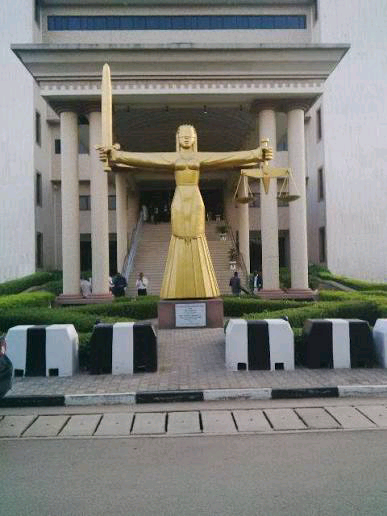
The Federal High Court in Abuja on Wednesday admitted the confessional statements of four defendants standing trial over the June 5, 2022 attack on St. Francis Xavier Catholic Church, rejecting the defence’s request for a trial-within-trial to determine their voluntariness.
Trial judge, Emeka Nwite, overruled the objection after listening to arguments from both the prosecution and defence, holding that the basis of the objection did not warrant a separate trial to test the admissibility of the statements.
“The objection of the defence is hereby overruled,” the judge ruled, admitting the statements made on August 18, 2022, and marking them as exhibits.
The four defendants — Al-Qasim Idris; his brother, Abdul-Halil Idris; Omeiza Abdulmalik; and his brother, Jamiu Abdulmalik — are being prosecuted by the Department of State Services on nine counts bordering on terrorism over the attack that left more than 40 worshippers dead and several others injured.
During proceedings, the prosecution sought to tender the original confessional statements of the first to fourth defendants through a DSS investigator identified as SSJ.
Defence counsel, A.A. Muhammad, “strongly” objected, urging the court to conduct a trial-within-trial to ascertain the circumstances under which the statements were obtained.
“The reason for the objection is that it is only two that cannot write; the other two can write,” the defence counsel argued. He further alleged that the statements “were taken in Akure under duress,” claiming the defendants were “tortured seriously before the statements were recorded.”
He also contended that the documents bore Abuja headquarters stamps without proper dates and visible thumbprints, insisting that the irregularities raised serious questions about their authenticity.
Relying on Section 157 of the Evidence Act, the defence urged the court to order a trial-within-trial “so that the facts of this matter could be known or established.”
In response, prosecution counsel argued that the objection was misconceived, maintaining that a trial-within-trial is only necessary where voluntariness is in issue.
“The law is settled that it is only when the voluntariness of a confessional statement is in issue that a trial-within-trial will be ordered,” counsel submitted.
He argued that the defence’s contention bordered on denial of authorship rather than involuntariness.
“When a defendant makes an outright denial, the denial is tantamount to a retraction of the statement,” he said, citing Supreme Court authorities including Ekwerewekwu v. State (2020) and Usman v. State (2022).
He urged the court to admit the statements and reserve any retraction arguments for final judgment.
Justice Nwite subsequently admitted the statements, holding that the objection lacked merit.
Earlier under cross-examination, the DSS investigator gave detailed testimony on the arrests and investigation.
He told the court that the defendants were arrested between August 9 and 17, 2022, in Kogi and Ondo states, though he could not recall the exact dates for each arrest.
Asked how many were arrested in Kogi State, the witness replied, “I don’t remember the exact number, but I know the fifth defendant was arrested in Kogi State.”
The defence pressed the witness on the whereabouts of a principal suspect identified as Odoba, said to be at large.
“You keep mentioning Odoba. Where is Odoba?” counsel asked.
“Odoba is at large,” the witness responded, adding that intelligence indicated he “hibernates and operates around Ogaminana” in Kogi State.
When asked why the principal suspect was not listed in the charge, the witness replied, “It is not within my power as an investigator to draft the charge.”
The investigator alleged that the defendants belonged to a cell of the Islamic State West Africa Province (ISWAP) known as “Asherba,” operating around the Niger-Kwara axis.
“The headquarters of ISWAP is in the Lake Chad region,” he testified, adding that the group operates cells in parts of Nigeria, including Kogi State.
The witness said investigations revealed that the defendants drove a vehicle to the scene of the attack and later snatched another vehicle from a worshipper returning from church.
He testified that explosives and live ammunition were used during the attack and that a post-blast report by the Nigeria Police Explosive Ordnance Disposal Unit had already been admitted in evidence.
According to him, eyewitnesses identified the first four defendants as participants in the attack.
“Victims and eyewitnesses identified the first four defendants as the attackers whom they saw in the church premises,” he said, alleging that the fourth defendant detonated explosives while others fired AK-47 rifles at worshippers.
He further claimed that technical evidence placed the defendants’ mobile phones around telecommunication cell sites near the church at the time of the attack.
“The technical evidence shows that their phones and conversations were around the telecommunication cell site locations during the period of the attack,” he said, adding that analysis of call data records formed part of a comprehensive investigation report.
The defence, however, challenged the non-production of certain documents, including communication records and search warrants.
“Where are the search warrants?” counsel asked at one point.
“For the second and fourth defendants, I think the warrant is with the legal service,” the witness replied.
On allegations that other suspects had been arrested and released, the witness said, “I’m not aware of any other arrest relating to this matter. Our arrests were intelligence-led.”
In his examination-in-chief, the DSS investigator said he personally interviewed the first to fourth defendants after administering cautionary words.
“I cautioned them not to say anything unless they say it voluntarily,” he told the court.
He said the defendants informed him they could not write in English, prompting him to invite the Director of the Legal Aid Council to serve as an independent witness during the recording of the statements.
“Each of the statements was read to them one after the other as what they actually said orally, and they all answered in the affirmative,” he testified.
He added that the defendants signed, dated and thumbprinted the statements in the presence of a senior investigating officer and the Legal Aid Council representative.
The matter was adjourned to February 19, 2026 for continuation of cross-examination.