

Folding Umbrella, Sweeping Broom and Mass Decampings
Folding Umbrella, Sweeping Broom and Mass Decampings
By 𝔸bdulrazak Tomiwa
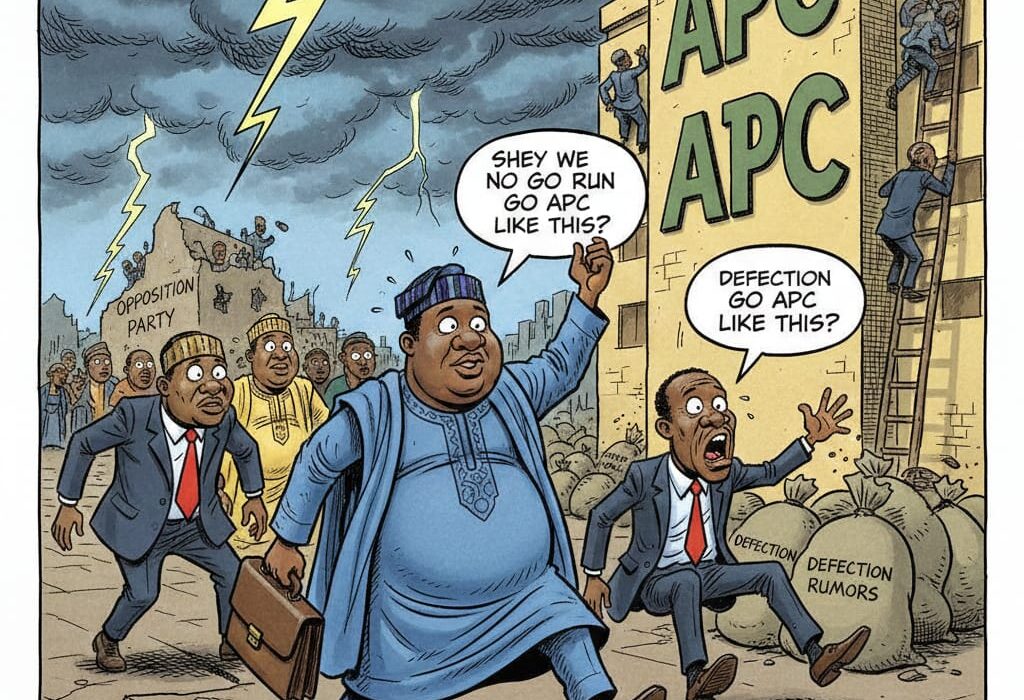
In the ever-shifting sands of Nigerian politics, the early days of 2026 have ushered in a spectacle that feels both like a seismic shift and a familiar routine: the “Great Migration” to the All Progressives Congress (APC). From the serene hills of Plateau to the bustling creeks of the South-South, the political landscape is buzzing as heavyweights from the opposition parties swap their colors for the ruling party’s broom. This mass exodus of governors, lawmakers, and seasoned power-brokers has transformed the APC into a massive political melting pot, leaving many to wonder what truly fuels this relentless pull toward the center.
At the heart of this movement is the cold, hard logic of political survival. In Nigeria’s highly centralized system, the “levers of power” are firmly held in the federal hands of the APC, which controls the national budget, major appointments, and the security apparatus. For a governor or a lawmaker, being in the opposition can feel like trying to run a marathon in a room with no oxygen; joining the ruling party is often seen as the only way to ensure their voices are heard when federal resources are being shared.
This migration is also driven by the implosion of the opposition, specifically within the Peoples Democratic Party (PDP) and the Labour Party (LP). Throughout late 2025 and into this year, these parties have been caught in a whirlwind of internal litigation, leadership tussles, and factional crises that have left their members feeling like they are aboard a sinking ship. When the home front is in chaos, the organized machinery of the APC led by figures like National Chairman Nentawe Yilwatda presents an image of stability that is hard for a frustrated politician to ignore.
The “connecting to the center” narrative has become the standard justification for these defections, as leaders claim they are prioritizing the development of their states over party loyalty. High-profile figures like Governor Caleb Mutfwang of Plateau and Governor Agbu Kefas of Taraba have signaled that aligning with the federal government is a strategic move to fast-track infrastructure and federal projects. While critics call it opportunism, supporters view it as a pragmatic sacrifice for the “common good” of their constituents.
There is also the looming shadow of the 2027 General Elections, with strategic positioning starting earlier than ever. By decamping now, politicians are buying “insurance policies” for their future ambitions, hoping to secure the ruling party’s ticket or patronage before the field becomes too crowded. For those whose second terms are ending, joining the APC is often a way to influence who succeeds them, ensuring their political legacy remains protected by the umbrella of the ruling party’s influence.
Furthermore, the absence of deep-seated ideology in Nigerian party politics makes these transitions remarkably smooth. Unlike in other democracies where crossing the carpet might involve a radical change in belief, Nigerian parties are often viewed as “special purpose vehicles” (SPVs) designed solely to transport candidates to power. When one vehicle breaks down or loses its speed, the driver simply hops into the one that is currently in the fast lane, making the switch a matter of logistics rather than conviction.
Another subtle but potent driver is the “fear of the anti-graft spotlight.” The ruling party often serves as a perceived “safe haven” for those who might otherwise face intense scrutiny from agencies like the EFCC. While the government officially denies using anti-corruption tools as a political weapon, the historical pattern suggests that those who carry the “broom” often find themselves under less pressure than those shouting from the opposition stands, creating a powerful incentive for politicians with “baggage” to seek refuge.
This wave of defections has also been fueled by President Bola Tinubu’s “Big Tent” strategy, which actively woos influential figures from rival camps to create a sense of national consensus. By bringing former foes into the fold, the administration aims to neutralize dissent and consolidate its grip on power across all six geopolitical zones.
This strategy has successfully turned formerly “hostile” states into APC territories, significantly altering the electoral map long before the first ballot is cast in the next cycle.
However, this trend has sparked a heated debate about the future of Nigeria’s multi-party democracy. Analysts warn that the continuous hollowing out of the opposition is leading the country toward a de facto one-party state, where checks and balances are weakened and the executive branch becomes increasingly unchecked. When the most vocal critics of today become the most loyal cheerleaders of tomorrow, the electorate is left with fewer choices and a growing sense of disillusionment with the democratic process.
Ultimately, the mass migration to the APC is a reflection of a political culture that prizes power over principle. As we move deeper into 2026, the broom of the ruling party continues to sweep across the nation, gathering a diverse array of politicians under one roof. Whether this consolidation leads to more effective governance or simply a more entrenched elite remains to be seen, but for now, the message is clear: in the game of Nigerian politics, the center is the only place most people want to be.