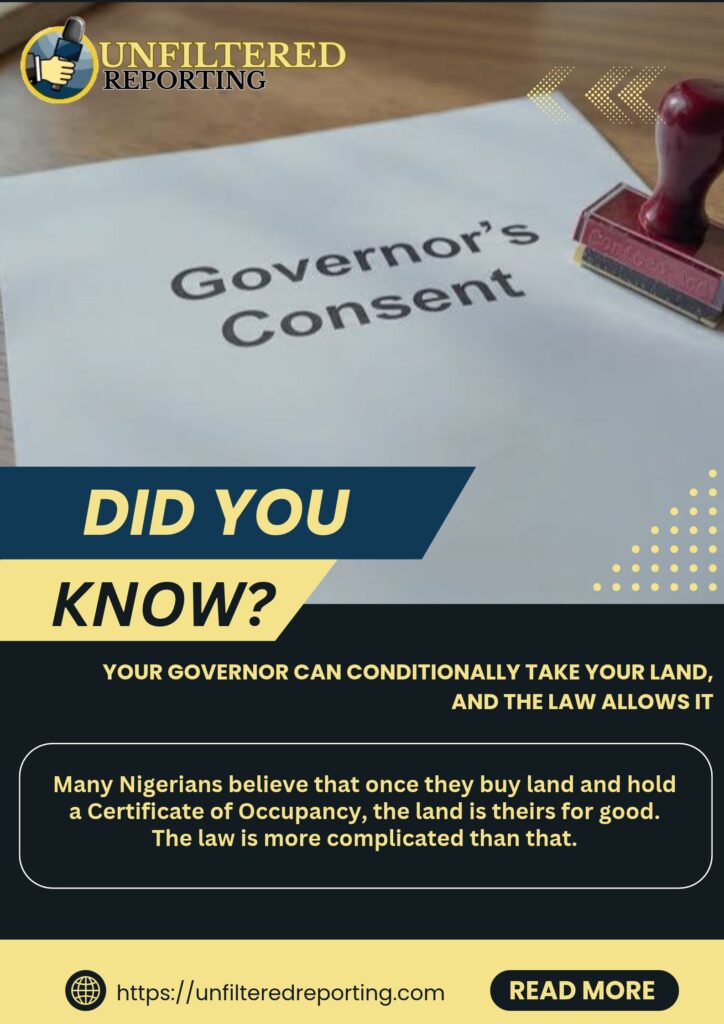


Did You Know? Your Governor Can Conditionally Take Your Land, and the Law Allows It

Many Nigerians believe that once they buy land and hold a Certificate of Occupancy, the land is theirs for good. The law is more complicated than that.
The Land Use Act of 1978 changed land ownership in Nigeria. Under the Act, all land in each state is vested in the Governor of that state, who holds it in trust and administers it for the common benefit of all Nigerians. So what you hold is not outright ownership in the old sense. You hold a right of occupancy, which is a right to use and enjoy the land, granted by the Governor (statutory right of occupancy) or by a Local Government (customary right of occupancy).
Section 28 of the Act is the key provision. It empowers the Governor to revoke a right of occupancy for overriding public interest. This applies to both statutory and customary rights of occupancy. In practice, this is how governments clear land for roads, bridges, airports, housing schemes and other public projects. The Constitution also recognises this power. Section 40 of the Constitution and Section 28 of the Land Use Act allow government to compulsorily acquire land where the purpose is overriding public interest.
The Governor can also revoke for reasons that concern the holder. These include breaching the terms of the grant, such as failing to develop the land as agreed or using it for a purpose not allowed in your title. They also include alienating the land (selling, transferring or mortgaging it) without the Governor’s consent.
Not legally, no. There are rules:
The revocation must be for a genuine overriding public interest or one of the grounds listed in the Act. The Governor cannot act on a whim or to favour a friend.
You must be given proper notice. The holder’s title ends on receipt of the notice of revocation, or on a later date stated in it. That notice must be signed by a duly authorised public officer. A revocation that ignores the proper procedure can be challenged in court.
You are not meant to lose your land for nothing. Both the Constitution and the Land Use Act require prompt payment of compensation to people whose right of occupancy is taken away for overriding public interest. Here is the catch that surprises many people: compensation under the Act is based on the value of the unexhausted improvements on the land, meaning buildings, crops and installations, not the land itself. Disputes over the amount go to the Land Use and Allocation Committee, or to the High Court, which has exclusive original jurisdiction in matters on statutory rights of occupancy.
Critics say the compensation process often falls short in practice. Scholars note that compulsory acquisition and compensation are often fraught with legal and practical difficulties. Some call for amendments, because the Act limits how far courts can hear disputes about the amount of compensation.
Get your title documents in order, including your Certificate of Occupancy and the Governor’s consent for any transfer. Develop the land according to the terms of your grant. Keep records of every improvement you make, because they determine your compensation. If you receive a revocation notice, speak to a land lawyer straight away, because you may have grounds to challenge it.
The Governor does have the legal power to take your land, but it is a conditional power. It must serve an overriding public interest, follow the correct procedure, and come with compensation. Knowing this can help you protect what you own.