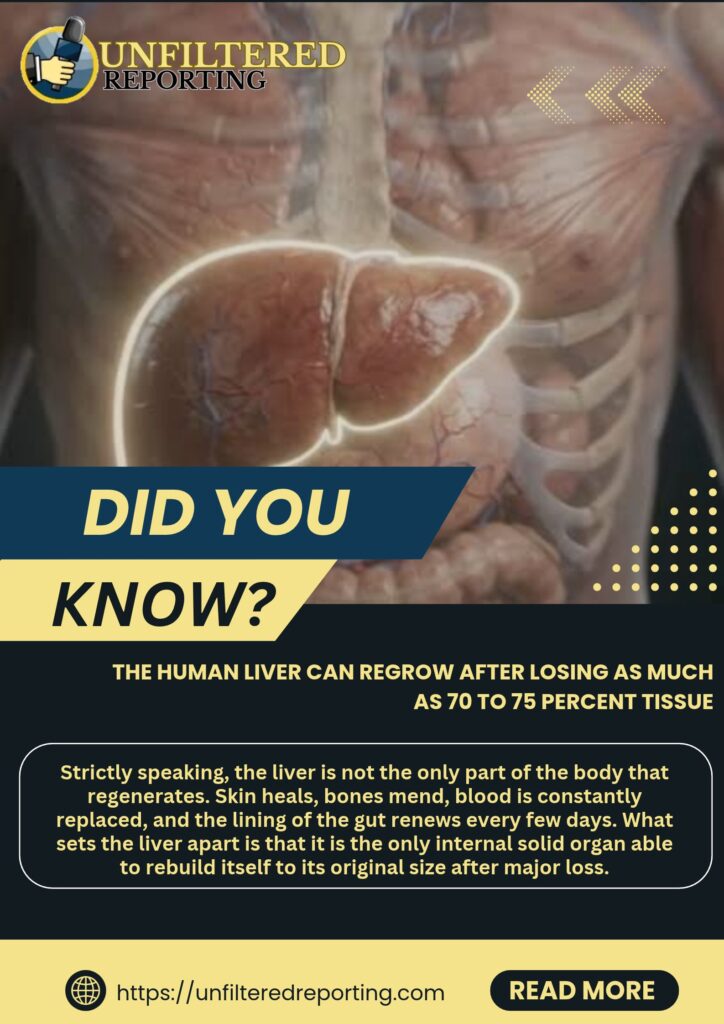



Did you know? The Human Liver can Regrow After Losing as Much as 70 to 75 Percent Tissue
Strictly speaking, the liver is not the only part of the body that regenerates. Skin heals, bones mend, blood is constantly replaced, and the lining of the gut renews every few days. What sets the liver apart is that it is the only internal solid organ able to rebuild itself to its original size after major loss.
The ancient Greeks told the story of Prometheus, who was chained to a rock as punishment while an eagle ate his liver each day, only for it to grow back each night. Whether they truly understood liver regeneration or simply admired the organ’s toughness, modern science has confirmed the idea behind the legend.
Normally, liver cells, called hepatocytes, rarely divide. They quietly handle hundreds of jobs: filtering toxins from the blood, producing bile to digest fat, storing energy, and making proteins that help blood clot.
When part of the liver is removed or damaged, chemical signals such as growth factors and immune molecules tell the remaining healthy cells to start dividing. This does not depend mainly on stem cells. The mature liver cells themselves multiply until the organ reaches the right size for the body, and then the process stops. That precise control matters, because cell growth that never stops is the hallmark of cancer.
The clearest evidence comes from living-donor liver transplants. A donor can give a large portion of their liver to a patient in need. Within weeks, both the donor’s remaining liver and the donated piece grow substantially, and within a few months the donor’s liver returns to nearly its original volume. One detail is worth knowing: the liver restores its mass and function, but not always its exact original shape.
This power is not unlimited. Repeated or long-term injury overwhelms the liver’s repair system. Heavy alcohol use, chronic hepatitis infections, and fatty liver disease can cause scar tissue to build up, a condition called cirrhosis. Scar tissue cannot do the work of liver cells, and once it is extensive, the liver can no longer regenerate effectively. Because liver disease often causes few symptoms until it is advanced, it can be dangerous without warning.
The liver’s resilience is a reason to look after it, not to take it for granted. Limiting alcohol, maintaining a healthy weight, getting vaccinated against hepatitis A and B, avoiding medication overuse (paracetamol overdose is a leading cause of acute liver damage), and eating a balanced diet all help keep it working well.
The liver can lose most of its tissue and rebuild itself, but it recovers best when we give it the chance, not when we damage it again and again.