



Duffy Demands $50 Billion Overhaul of US Ageing Air Control System After Hour-long Traffic Failure
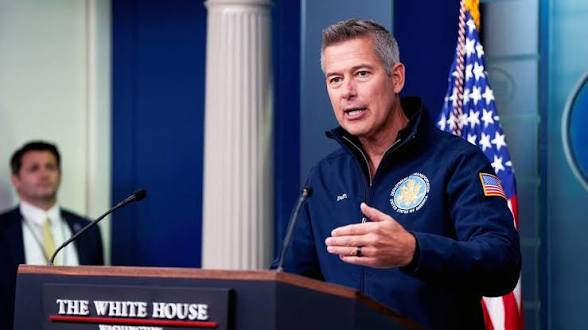
US Transportation Secretary, Sean Duffy has urged Congress to approve $50 billion in emergency funding to rebuild the country’s ageing air traffic control system.
His call came after an equipment failure triggered a nationwide ground stop that grounded flights across the United States on Friday.
The Federal Aviation Administration halted all departures after communications problems hit its regional air traffic control centres, which direct planes flying between airports. Duffy said instability in radar and communications systems began at 3:36 p.m. Eastern Time. Airspace reopened at 8:15 p.m., but he warned that flights would resume gradually. “It’s going to be slow,” he told reporters at the White House.
Duffy said the system’s switches and routers became overloaded with data and began producing inconsistent information, which led officials to shut it down. He insisted that controllers never fully lost radar or communications and were able to land thousands of aircraft safely. He said the immediate fault had been fixed and that flying was safe.
The disruption was severe. According to FlightRadar24, more than 6,600 flights were cancelled and 8,600 delayed, with a further 1,500 already cancelled for Sunday. Tens of thousands of passengers were stranded from Boston to Seattle, and many were expected to spend the night in terminals.
It was the longest nationwide shutdown since the September 11, 2001 attacks. The only other nationwide ground stop since then came in January 2023, when domestic departures were halted for about 90 minutes.
Airlines are not required to compensate stranded passengers because the failure was not their fault. Shares in American Airlines, United and Delta fell by 1 to 2 percent in after-hours trading, while JetBlue dropped about 3 percent.
Homeland Security Secretary Markwayne Mullin said there was “zero evidence” so far that a cyberattack or rogue AI system was responsible. He added that investigators had not ruled either out and that the National Security Agency was assisting the probe. “It appears this was mechanically driven,” he said.
Two airline officials told Reuters the outage appeared to affect a telecommunications network overseen by L3Harris Technologies, which carries the radio frequencies controllers use to speak to pilots. The company did not respond to a request for comment.
Duffy used the crisis to press Congress for funds, saying the country has “an incredibly old air traffic control system.” He noted that lawmakers had already approved $12.5 billion over five years in July 2025 for air traffic control upgrades and more controller hiring, but said much more was needed.
Earlier on Friday, before the outage, the White House and the Transportation Department had asked Congress for $30.1 billion for airport and air traffic control upgrades. That request included $10.1 billion for air traffic control modernisation. Duffy raised the figure to $50 billion after the shutdown. The $50 billion is a request and has not been approved by Congress.
The failure is the latest sign of strain on an air traffic system that has long struggled with outdated technology, equipment faults and a shortage of several thousand controllers.