
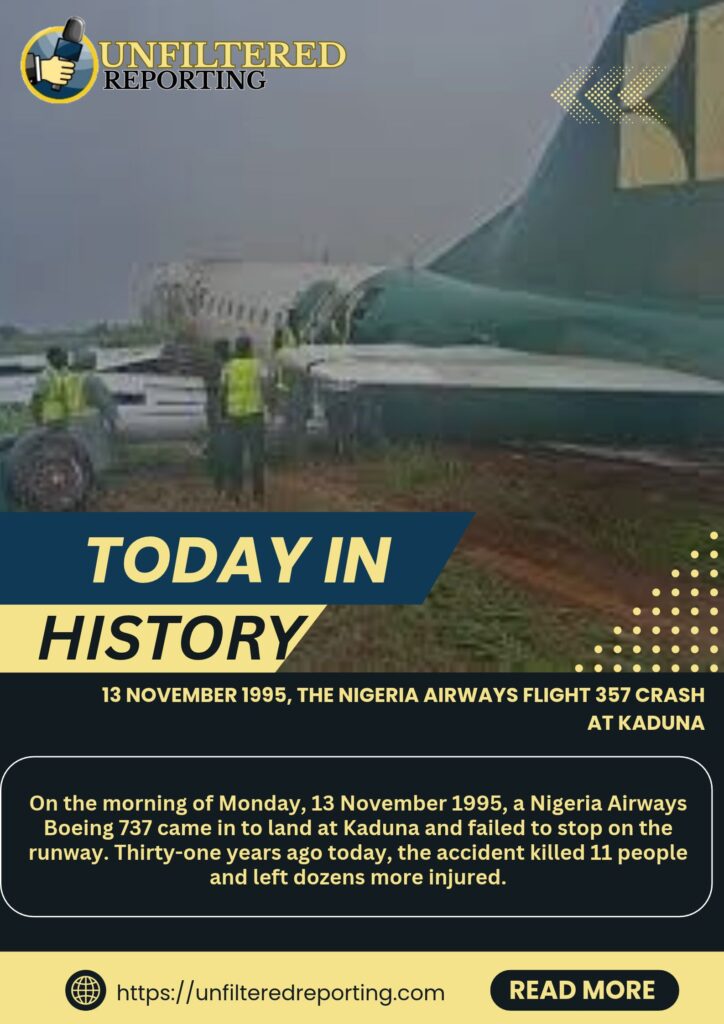


Today in History: 13 November 1995, the Nigeria Airways Flight 357 Crash at Kaduna
On the morning of Monday, 13 November 1995, a Nigeria Airways Boeing 737 came in to land at Kaduna and failed to stop on the runway. Thirty-one years ago today, the accident killed 11 people and left dozens more injured.
Nigeria Airways Flight 357 was a scheduled domestic service. It was meant to run from Yola to Lagos, with stops at Jos and Kaduna. The aircraft was a Boeing 737-2F9 registered 5N-AUA. It was built in 1983 and had logged about 22,375 flight hours. The flight left Yola, landed at Jos at 07:40 and took off again about fifty minutes later. There were 138 people on board, and the plane carried enough fuel. That was 124 passengers and 14 crew.
Trouble started with the choice of runway. Air traffic control cleared the flight to approach runway 05, but the captain asked to land on runway 23 instead. The official Nigerian investigation found that this meant the captain accepted a landing with a tailwind. A tailwind pushes a landing aircraft faster over the ground and lengthens the distance it needs to stop. That matters even on a long runway, and Kaduna’s runway is 3,000 metres long. The investigators concluded that pilot error led to an unstable approach and then a runway overrun. The wreckage came to rest at the end of runway 23, at 0753 UTC, which was 08:53 local time.
The overrun was followed by fire. The blaze destroyed the aircraft. Passengers and crew had to escape from a burning plane, and the casualty figures show how hard that was. All 14 crew members survived, but 11 of the 124 passengers died. Another 66 people were injured but survived. Some early press summaries gave lower death counts, but the investigation-based records settle on 11.
The investigation by Nigeria’s Accident Investigation Bureau took almost two years. The final report, No. 04/354, was released on 18 July 1997. The report named the pilot-in-command, Captain I. B. Dambazau, and the first officer, Captain C. A. Elom. Besides the landing decision, it recorded that the aircraft itself was in good condition. It also noted undue interference with the flight by the airline’s dispatch officers. That points to pressure from the operational side of the airline, in addition to the crew’s own handling of the approach.
The crash came during a very bad stretch for the airline. It was the fourth Nigerian aircraft to crash in five months. The earlier losses included a cargo aircraft in January 1995 that killed all three crew, and a DC-10 that caught fire shortly after takeoff in February. There was upheaval at the top as well. The airline’s board had been replaced in August 1995. Nigeria Airways went on to be dissolved in the early 2000s and was succeeded by Virgin Nigeria.
Flight 357 is remembered as a lesson in how a single decision on approach can overwhelm the safety margin of a long runway. It is also remembered for the 11 passengers who did not reach their destination. Their deaths are part of the history of aviation safety in Nigeria. Thirty-one years on, the crash is a reminder of why stable approaches, runway discipline and crews free from commercial pressure matter.