

Tinubu’s Reward System Positively Impacting Nigerian Sports
By Bamidele Atoyebi
I have watched with keen interest how the reward system under President Bola Ahmed Tinubu has continued to change the narrative around sporting excellence in Nigeria. Since assuming office in May 2023, the President has not merely celebrated Nigerian athletes with words but has backed several major sporting achievements with national honours, housing, cash rewards and other forms of tangible support. From the Super Eagles and Super Falcons to D’Tigress, the Paralympic team and the newly crowned Flamingos, the enduring message is clear: excellence in Nigerian sports is being recognised, appreciated and rewarded.
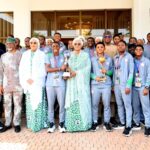
A case in point was that the Super Eagles finished runners-up at the 2023 Africa Cup of Nations. President Tinubu approved national honours, houses and plots of land for the 45 players and officials who constituted the contingent. The Federal Government subsequently made good it’s promise by handing the title documents for the houses, certificates of national honour and confirmation of the Abuja land allocations in December 2025. To me, the significance goes beyond the material value of the rewards. It demonstrates that when athletes sacrifice their time, careers and comfort to put Nigeria on the global stage, government can follow up its promises with concrete action.
The same approach has been particularly visible in women’s sports. After the Super Falcons won their record-extending 10th Women’s Africa Cup of Nations title, President Tinubu conferred the Officer of the Order of the Niger on all 24 players and the 11-member technical team. Each player received approval for the naira equivalent of $100,000, while technical and backroom staff were approved for $50,000 each, alongside three-bedroom apartments in Abuja. The reward package for D’Tigress followed a similar pattern after they won their fifth consecutive FIBA Women’s AfroBasket title, with players and officials receiving national honours, housing and cash awards.
What makes the policy even more significant is the emphasis on fulfilment rather than prouncements alone.
The National Sports Commission confirmed in September 2026 that the D’Tigress players had received the naira equivalent of their $100,000 cash reward, while officials received their $50,000 equivalent. This completed the package of houses, national honours and cash approved for the team. The Super Falcons had also received their housing documents and national honour certificates, with their cash payments being processed. This is important because Nigeria has a long history of athletes waiting years for government promises to be fulfilled. A reward system only inspires confidence when beneficiaries can actually receive what was promised.
For perspective, the United States offers $37,500 for an Olympic gold while France offers about $87,000, with Hong Kong and Singapore among the countries offering substantially higher individual Olympic bonuses. Nigeria, however, is taking a broader approach to rewarding sporting success, with the Federal Government combining substantial financial rewards with housing, national honours and other welfare benefits for athletes who deliver major continental and global victories. The approach is particularly significant because Nigeria’s rewards extend across entire championship-winning teams rather than being limited to individual medalists, meaning the total value of the country’s commitment can run into millions of dollars for a single successful squad. With the latest rewards for the Flamingos and the earlier packages for the Super Falcons and D’Tigress, Nigeria is demonstrating that sporting excellence is not only celebrated with medals and praises but is increasingly being backed with tangible benefits that recognise athletes as national assets and reward their contribution to the country’s international standing.
I believe the most powerful evidence that President Bola Ahmed Tinubu is rewriting Nigeria’s sporting history is not only in the size of the rewards, but in the message the rewards are sending to the next generation. In Dakar, 17-year-old Rosemary Nwankwo won the women’s 100m at the 2026 Youth Olympic Games in 11.16 seconds, while 16-year-old Praise Ugoh became Nigeria’s first-ever Youth Olympic women’s 400m champion with a personal-best 52.76 seconds. Nigeria also has the remarkable Dazzle FC Under-12 side from Lagos, which won the 2026 Dana Cup in Denmark after competing against teams from 56 countries, winning all nine of its matches and defeating Mexico’s IFAC in the final.
These are not isolated victories; they are evidence of the depth of Nigerian talent. What I find particularly encouraging is that this is happening at a time when the Federal Government is making sporting excellence materially valuable. President Tinubu’s reward system has moved beyond applause to cash, housing, national honours and investment. The D’Tigress, for instance, eventually received the naira equivalent of $100,000 per player and $50,000 per official, alongside their houses and OON honours, with the National Sports Commission confirming in September that the entire package had been redeemed. The same philosophy is now being applied to the Flamingos, with their reported ₦100 million player awards structured as five-year government savings bonds rather than simply handed over as cash. This, to me, is employee motivation in action: when people see that extraordinary hard work can attract extraordinary recognition, they have another reason to remain committed, disciplined and passionate about representing Nigeria.
The impact also extends beyond football and basketball. Nigerian athletes at the Paralympic Games and other international competitions have increasingly become part of a system that recognises performance. The administration’s performance-based approach means that medals are not treated merely as statistics on a competition table but as achievements deserving immediate recognition. The National Sports Commission’s incentive structure, including instant cash rewards for medal-winning athletes at multi-sport competitions, further reinforces the idea that every athlete carrying the Nigerian flag deserves to know that the country is watching and appreciates the sacrifice behind the medal.
Then came another powerful statement in November 2026, when the Flamingos became the first African team to win the FIFA U-17 Women’s World Cup. President Tinubu congratulated the young players after their historic 2-1 victory over Japan in Rabat, describing the triumph as a landmark achievement for African women’s football. The response to the victory has also shown a deliberate attempt to connect sporting rewards with the future of the athletes. Rather than simply handing young players a large amount of cash, the reported reward structure places the ₦100 million player awards in five-year Federal Government Savings Bonds, creating an investment-oriented pathway for the beneficiaries.
But to appreciate how significant this shift is, I think we must remember where we are coming from. Nigeria has a painful history of promising athletes rewards and allowing those promises to linger for years. The 1996 Atlanta Olympic heroes are perhaps the clearest example. Chioma Ajunwa waited 25 years before receiving the house promised to her for winning Nigeria’s first individual Olympic gold; Lagos eventually fulfilled that pledge in 2021. Daniel Amokachi also recalled in 2026 that federal and state governments made several promises to the Dream Team after their historic Olympic triumph, many of which remained unfulfilled three decades later; Kaduna Governor Uba Sani only recently allocated land to Amokachi, Garba Lawal and Emmanuel Babayaro. Even Jo Bonfrère, the coach who led that team to Olympic gold, said in October 2026 that he was still waiting for a promised reward 30 years later. That is the old narrative I believe Tinubu is deliberately trying to change. I am not arguing that every problem in Nigerian sports has disappeared, because it has not. But there is now a visible contrast between promise and fulfilment. When President Tinubu says, “a promise made must be a promise kept,” and the rewards actually reach athletes, that creates a different incentive structure. I believe the same principle explains why many talented Nigerians have historically sought opportunities elsewhere: when athletes, creatives and other professionals repeatedly see their rewards in what could be termed suspended animation or delayed recognition at home, they look for systems that value their talent. Tinubu’s sports interventions therefore deserve to be judged not only by the money spent today, but by the confidence they can build among tomorrow’s athletes. If Nigeria can make young people like Rosemary Nwankwo, Praise Ugoh and the Dazzle FC boys believe that winning for Nigeria can bring recognition, dignity and tangible reward, then we are not merely celebrating champions; we are rebuilding the incentive to become one.
I believe this is where the reward system becomes more than a political gesture. When a young Nigerian sees a player receive a house, a national honour, substantial financial support or an investment instrument because of sporting excellence, the perception of sports can begin to change. A child who previously saw football, basketball, athletics or para-sports merely as entertainment can begin to see them as legitimate pathways to achievement, recognition and financial security. The success of the Super Falcons and D’Tigress, particularly, also sends a powerful message to Nigerian girls that their talent can earn them national recognition and that women’s sporting achievements are worthy of serious investment.
Ultimately, I see President Tinubu’s sporting reward policy as part of a broader effort to restore confidence among Nigerian athletes. The country cannot demand global medals from athletes while treating their sacrifices as an afterthought. Rewards alone will not solve every problem in Nigerian sports; infrastructure, grassroots development, coaching, welfare, sports science and effective administration remain essential. But recognition matters. By linking outstanding performances to tangible rewards and, in several cases, ensuring that the promises are actually redeemed, the Tinubu administration is establishing a culture in which sporting excellence has consequences beyond applause. For me, that is the real positive impact: the Nigerian athlete is increasingly being told not only to win for the country, but that the country will also remember and reward the win.
Comrade Bamidele Atoyebi, the Convenor of the Bola Ahmed Tinubu Ideological Group, is also the National Coordinator of Accountability and Policy Monitoring PR, and a publisher of Unfiltered and Mining Reports.