

Yoruba Group Calls for Oduduwa Republic, Seeks Limits on Non-Indigenes
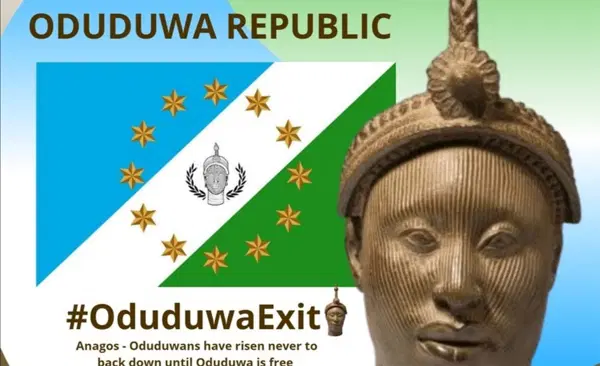
The Yoruba Self Determination Movement (YSDM) has renewed its demand for the creation of an independent Oduduwa Republic, alongside proposed restrictions on the political participation, property ownership and commercial activities of non-indigenes in parts of South-West Nigeria.
The group presented its demands on Wednesday during a press conference organised by the Yoruba Action Group at the Nigeria Union of Journalists Press Centre in Iyaganku, Ibadan, Oyo State.
The movement’s Deputy Leader (Homeland), Architect George Akinola, attributed the agitation to Nigeria’s security challenges, political tensions and disagreements over ethnic identity and territorial ownership.
Akinola argued that restructuring, resource control and a return to regionalism would not resolve the country’s fundamental problems, insisting that the creation of a separate Yoruba nation remained the group’s preferred solution.
He maintained that the current political arrangement had failed to adequately protect Yoruba political, economic and cultural interests.
The group also called for tighter migration controls in Yoruba urban centres and restrictions on non-indigenes’ participation in elections, land transactions and commercial activities.
The movement rejected claims that Lagos is a no-man’s land and disputed assertions about the role of other ethnic groups in the state’s historical development.
It argued that Yoruba communities, including the Awori, Ijebu, Egba, Egbado, Remo, Ilaje and Egun, alongside Yoruba returnees from Sierra Leone, contributed significantly to the historical development of Lagos.
The group also challenged accounts of historical Bini sovereignty over Lagos, arguing that the traditional succession system on Lagos Island reflected Yoruba ruling-house arrangements.
Akinola further alleged that political developments during the administration of former Lagos State governor Bola Tinubu between 1999 and 2007 contributed to increased political representation and property ownership by Igbo residents.
The movement subsequently declared that Igbo candidates should not contest elections in Yorubaland during the 2027 general elections, arguing that political participation should be based on indigeneity.
It also called on political officeholders and lawmakers across the South-West to introduce legislation that would protect what it described as the interests of indigenous communities.
Among the group’s major proposals is a demand that non-indigenes should occupy or control no more than 20 per cent of shops and commercial spaces in any market.
It specifically mentioned Alaba, Ladipo and the Trade Fair Complex markets in Lagos, alleging that Yoruba traders had experienced intimidation and exclusion in some commercial establishments because of their ethnic background.
The movement urged state authorities to investigate alleged discriminatory practices and introduce measures to protect indigenous traders.
It also proposed limiting land leases granted to non-indigenes to 20 years or less, compared with the 99-year lease arrangements it referenced.
Additionally, the group called for the identification and repatriation to their states of origin of non-Yoruba residents convicted of crimes. It also advocated tighter migration controls and the revocation of properties where, according to its allegations, hostile groups had gathered.
Akinola said the proposed measures were necessary to prevent what he described as the concentration of commercial and political power in the hands of particular ethnic communities.
The movement also demanded an end to open cattle grazing across Yorubaland, arguing that cattle owners from outside the region should establish ranches in their states of origin.
The group linked its demand for self-determination to persistent insecurity in rural communities, alleging that farmers and other residents had suffered kidnappings, killings, sexual violence and other attacks by armed groups operating in forests, villages and along highways.
It accused the Federal Government of failing to adequately address threats to Yoruba communities and argued that the security situation had strengthened the case for an independent state.
The movement also made historical claims concerning the origins and development of the Fulani and Igbo peoples. These assertions were presented as the group’s position and were not independently established.
Akinola warned that Yoruba people would respond to what he described as continued provocations and attempts to challenge their territorial identity.
He cited historical episodes, including conflicts involving Yoruba communities in the 19th century, the political crisis in the former Western Region in 1963, the disputed 1983 Ondo State governorship election and the annulment of the June 12, 1993 presidential election, widely believed to have been won by the late Chief Moshood Abiola.
The movement argued that these events demonstrated what it considers the determination of Yoruba people to resist political domination and perceived threats to their interests.
Akinola also referenced Chinua Achebe’s novel *Things Fall Apart*, using a passage about responding to violations of personal boundaries to reinforce his warning against what he described as disrespect for Yoruba history and culture.
The movement challenged the legitimacy of Nigeria’s 1999 Constitution, arguing that Yoruba representatives were not adequately involved in its drafting and that the document failed to reflect the consent of the country’s constituent ethnic nationalities.
It maintained that ethnic nationalities should be allowed to pursue self-determination and establish safeguards for their cultural identities and indigenous interests.
However, Nigeria’s Constitution describes the country as an indivisible and indissoluble sovereign state and does not provide a unilateral constitutional procedure for an ethnic group or state to secede from the federation.
The Constitution also protects citizens against discrimination on grounds including ethnic group and place of origin, while guaranteeing Nigerians the right to acquire and own immovable property anywhere in the country, subject to constitutional provisions.
The YSDM said it would continue campaigning for an independent Oduduwa Republic, maintaining that restructuring and other constitutional reforms would not address what it considers Nigeria’s fundamental challenges.
The group urged political leaders, traditional rulers and community representatives across the areas it identifies as Yorubaland to support its self-determination campaign and proposed legislative restrictions.