

Today in History: Inside the June 20, 2002 Bush-Obasanjo Oval Office Parley
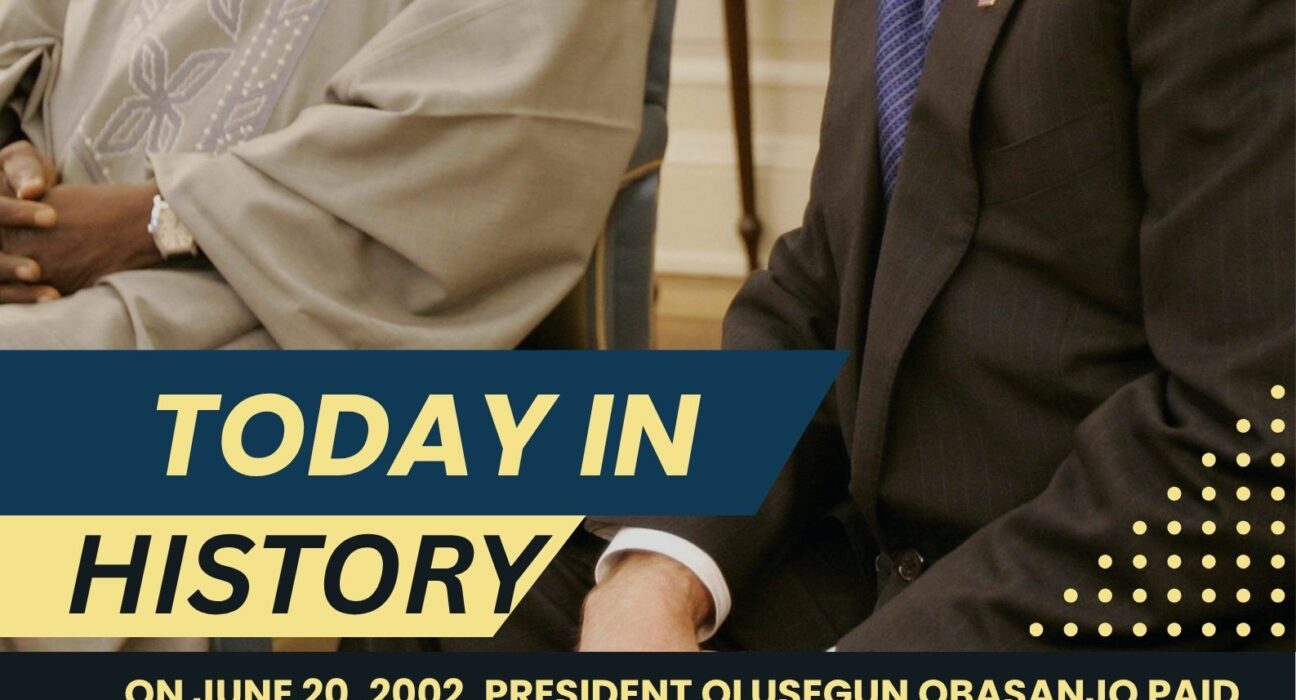
On June 20, 2002, then Nigeria’s President, Olusegun Obasanjo arrived at the White House in Washington, D.C., for a private working session with U.S. President, George W. Bush. Occurring just three years into Nigeria’s transition back to democratic governance and less than a year after the catastrophic events of September 11, 2001, this meeting served as a critical anchor for U.S.-Nigeria relations during a deeply turbulent era in global politics. The brief, candid nature of this private visit provided both leaders an unfiltered space to align on overlapping economic, regional, and security issues.
The dominant backdrop of global diplomacy in 2002 was the U.S.-led “War on Terror.” For President Bush, solidifying partnerships with stable African democracies—especially nations with large Muslim populations was a chief strategic imperative. President Obasanjo brought a highly unique perspective to the Oval Office. Representing a nation split almost evenly between Christian and Muslim citizens, Obasanjo had consistently advocated for religious tolerance and internal stability within Nigeria. During their talks, Obasanjo reaffirmed Nigeria’s support for counter-terrorism efforts while emphasizing that the global fight was against violent extremism, not the Islamic faith itself. This alignment positioned Nigeria as America’s vital strategic anchor in West Africa.
Beyond global counter-terrorism, the two heads of state spent significant time mapping out solutions for ongoing civil conflicts roiling the African continent. Nigeria had long been the economic powerhouse and primary military backbone of ECOMOG (the Economic Community of West African States Monitoring Group), making Obasanjo the indispensable partner for regional stability.
The leaders focused heavily on navigating the unstable regime of Charles Taylor in Liberia and charting a path toward democratic transition. They also discussed supporting delicate peace processes to resolve protracted civil wars in Angola and the Democratic Republic of Congo, alongside addressing the political crisis following contested presidential elections in Madagascar. President Bush explicitly praised Obasanjo’s leadership in deploying Nigerian peacekeepers to these volatile conflict zones and discussed ongoing U.S. technical and logistics training for Nigerian military forces.
The meeting was not entirely dominated by military and security strategy. The year 2002 marked a critical turning point in the global response to the HIV/AIDS epidemic, which was tearing through Sub-Saharan Africa. President Obasanjo was recognized on the international stage for his transparency and aggressive domestic campaigns against the virus. During the visit, President Bush reaffirmed the U.S. commitment to standing alongside African leaders to combat the pandemic—a commitment that would eventually culminate in the historic launch of PEPFAR (the President’s Emergency Plan for AIDS Relief) the following year.
Concurrently, the leaders discussed economic liberalization. Obasanjo sought U.S. trade partnerships and foreign direct investment to support his domestic economic reforms, utilizing frameworks like the African Growth and Opportunity Act (AGOA) to boost non-oil exports. However, Nigeria’s status as a top-tier oil producer remained an undeniable point of mutual economic interest, particularly as the U.S. sought to diversify its energy imports away from a volatile Middle East.
The private meeting on June 20, 2002, cemented a strong personal rapport between Bush and Obasanjo. Rather than leaning on rigid, public state dinners, the private format allowed the two men to speak straightforwardly as counterparts. By the end of the summit, the diplomatic footprint was clear: Nigeria was no longer viewed through the prism of its past military juntas, but rather as an essential, democratic partner capable of shaping the economic and political trajectory of the entire African continent.