


Fix Power Sector Crisis, Manufacturers, LCCI Charge Tegbe
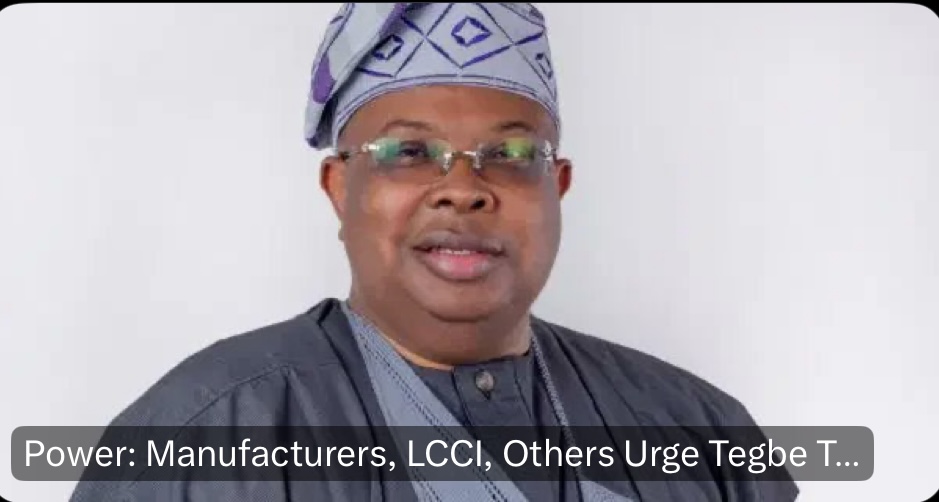
Key stakeholders in Nigeria’s power sector, including the Manufacturers Association of Nigeria (MAN), the Lagos Chamber of Commerce and Industry (LCCI), and electricity generation companies, have called on the Minister of Power, Joseph Olasunkanmi Tegbe, to urgently address the liquidity crisis and recurring national grid failures threatening the country’s economy.
The stakeholders warned that the worsening financial instability in the electricity sector could further cripple industries and discourage investment if decisive reforms are not implemented.
The Association of Power Generation Companies (APGC) disclosed that power generation firms are currently owed over ₦6 trillion, a situation it described as unsustainable for operators struggling with rising operational costs and poor remittances from distribution companies.
Chief Executive Officer of APGC, Joy Ogaji, urged the minister to prioritise payment discipline, strengthen transmission infrastructure, and enforce contractual obligations across the electricity value chain to restore confidence in the sector.
She warned that without urgent intervention, persistent liquidity challenges and weak infrastructure could lead to more frequent grid collapses and reduced power generation nationwide.
Also reacting, the Centre for the Promotion of Private Enterprise (CPPE) stressed the need to close the country’s metering gap, noting that millions of electricity consumers still rely on estimated billing.
CPPE Chief Executive Officer, Dr. Muda Yusuf, said unreliable electricity supply and high energy costs have continued to increase production expenses for manufacturers, forcing many businesses to depend heavily on diesel generators.
According to him, energy costs now account for a significant portion of manufacturing expenses, worsening the challenges faced by industries already battling inflation and foreign exchange pressures.
The Lagos Chamber of Commerce and Industry also expressed concern over repeated grid disturbances, warning that continued power instability could negatively affect manufacturers, small businesses, and economic productivity across the country.
Similarly, the Manufacturers Association of Nigeria criticised the performance of the privatised power sector, arguing that electricity supply has remained poor despite recent tariff increases for Band A consumers.
MAN Director-General, Segun Ajayi-Kadir, said industries are struggling to cope with rising electricity tariffs, high borrowing costs, and unstable power supply, which continue to undermine productivity and competitiveness.
Responding to concerns raised by stakeholders during his Senate screening, Tegbe admitted that Nigeria’s electricity challenges require long-term reforms but assured Nigerians that his administration would pursue transparent policies aimed at improving power supply.
The minister pledged to stabilise the national grid, improve metering, increase gas supply to power plants, and strengthen collaboration with state governments and private investors under the Electricity Act 2023.
He also promised to introduce accountability measures and performance monitoring mechanisms to ensure measurable improvement in the power sector.