



Did You Know? Why Electrical Plugs Come in Different Shapes
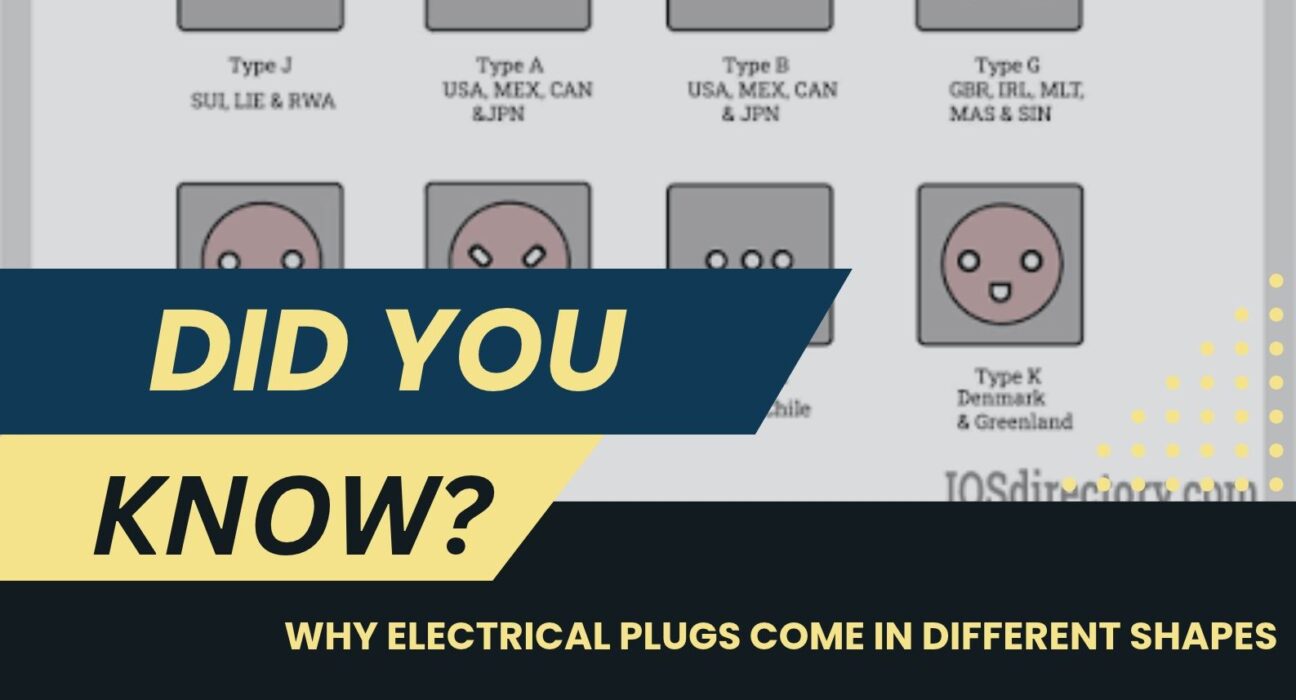
Did you know that the plug on your phone charger, your kettle and your television may look completely different from one in another country, and that the difference is not accidental?
Have you ever noticed that some plugs have two round pins, some have three pins arranged in a triangle, and others have just two flat blades? There is a reason for each design.
When electricity first reached homes in the late 1800s and early 1900s, each country, and sometimes each manufacturer, developed its own system. Countries chose different voltages and frequencies, and because there was no international agreement, each region designed sockets and plugs to suit its own needs. Today, the International Electrotechnical Commission (IEC) recognises 15 plug and socket types, labelled Type A to Type O, and different parts of the world still use different ones.
A two-pin plug carries just two connections: live and neutral. This is enough to power a device. Two-pin plugs are common on devices that are double-insulated, known as Class II appliances. These have extra layers of insulation inside, so a fault is very unlikely to make the outer casing live. Phone chargers, laptop adapters, hair dryers and many small gadgets fall into this group, which is why they do not need a third pin.
Two-pin plugs also come in different forms. Flat parallel pins are used in the USA, Canada and Japan (Type A), while two round pins are used across much of Europe and parts of Asia and Africa (Type C, often called the Europlug).
The third pin is an earth (ground) pin, and it exists for safety. If a fault occurs, such as a loose wire touching a metal body, the earth pin gives the dangerous current a safe path to the ground instead of through your body. This is why metal-bodied appliances such as irons, kettles, fridges and microwaves usually come with three-pin plugs.
In many three-pin designs, the pins are placed in a triangular layout. This prevents wrong insertion, since the plug can only fit one way and the live, neutral and earth connections always line up correctly. It also allows extra safety features. In the British-style Type G plug, which is also widely used in Nigeria, the earth pin is longer than the other two. It opens protective shutters inside the socket, so a child cannot poke a key or a pin into the live and neutral holes. Type G plugs also contain a built-in fuse, which cuts off power if too much current flows.
Round and flat pins come down to history and engineering choices made by different countries. Round pins are cheap to manufacture, and the Type C and Type F designs spread widely through Europe. Flat pins became the standard in North America. Type D (three round pins, used in India) and Type G (three rectangular pins) are legacies of the British Empire, which is why former colonies often still use them.
The shape of a plug is partly a safety system. It controls which devices can connect to which voltage, ensures correct wiring, and protects people from shocks. This is also why you should never force a plug into a socket, and why a travel adapter alone is not enough: an adapter changes the shape, but not the voltage. Always check that your device supports the local voltage (look for “100-240V” on the label) before plugging in abroad.
So the next time you plug in a device, take a second look at the pins. Each shape tells a story of safety, history and engineering.