

2027: Group Intensifies Call for Christian Governor in Kwara
By Momodu Favour
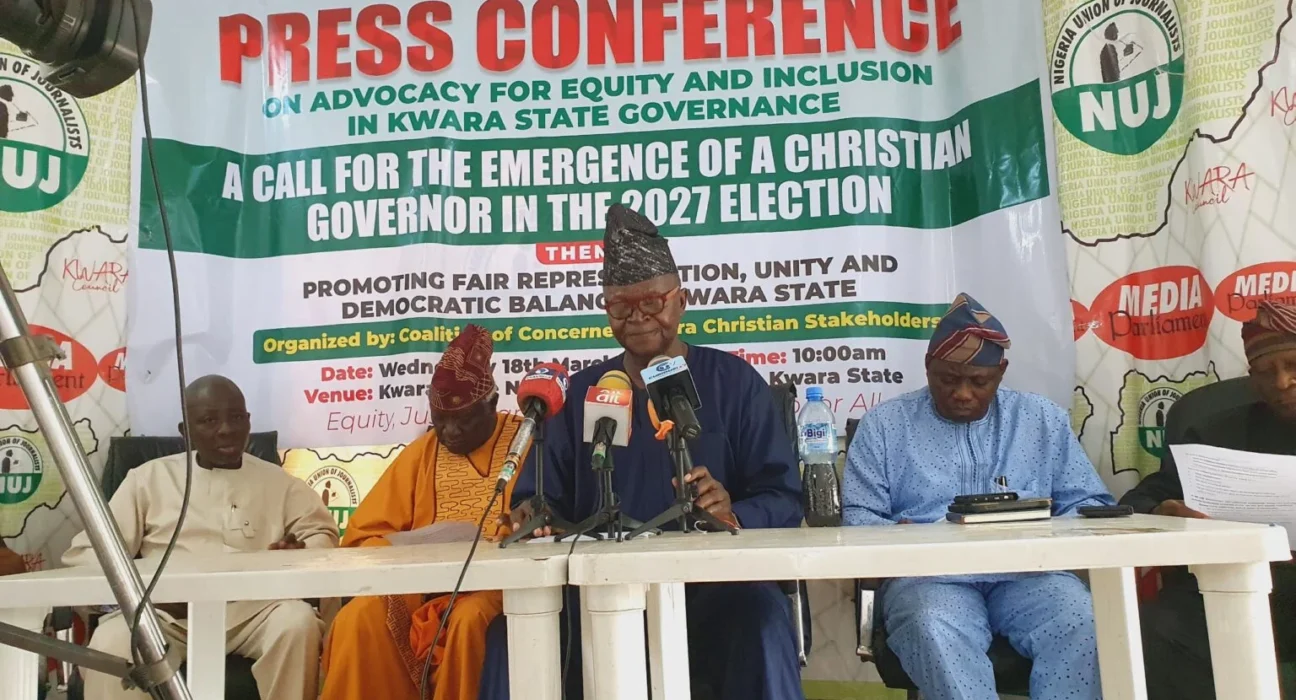
A coalition of Christian stakeholders in Kwara State has renewed its call for the emergence of a Christian governor ahead of the 2027 general elections, citing the need for inclusivity, fairness, and balanced representation in the state’s leadership.
The group, operating under the banner of the Coalition of Concerned Kwara Christian Stakeholders, made its position known on Wednesday during a press conference in Ilorin, the state capital. The stakeholders urged political leaders and parties to prioritise equity in the selection of candidates for the governorship race.
Addressing journalists, the coalition’s spokesperson, Rev. Jonathan Adegboye, said the demand was not driven by religious bias but by a desire to correct what he described as a longstanding imbalance in the state’s political structure.
According to him, Kwara’s diverse demographic composition — spanning ethnic groups such as Yoruba, Nupe, Baruba, Fulani, Igbo, and Hausa, as well as adherents of Christianity, Islam, and traditional beliefs — should be reflected in its leadership.
He warned that failure to promote inclusivity could threaten the state’s reputation for peaceful coexistence.
“We are advocating fairness and equal representation, not religious division,” Adegboye said. “Kwara’s identity is rooted in diversity, and this should be mirrored in how leadership positions are distributed.”
The coalition highlighted that since the creation of Kwara State, only one Christian Chief C. O. Adebayo has served as a civilian governor, and that was briefly in 1983. Since then, all elected governors have been Muslims.
They listed past leaders including Adamu Attah, Shaaba Lafiagi, Mohammed Lawal, Bukola Saraki, Abdulfatah Ahmed, and the incumbent governor, AbdulRahman AbdulRazaq, noting that the trend underscores what they described as decades of political imbalance.
The group maintained that its call is a legitimate push for inclusiveness rather than an attempt to politicise religion. It also cautioned against what it termed the “weaponisation of religion” in political decision-making.
“This is about giving every segment of Kwara society a sense of belonging,” the coalition stated. “After multiple administrations led by Muslim governors, it is only fair that Christians are given an opportunity to lead.”
In addition to advocating for a Christian governor, the group called for broader political inclusion, urging parties to ensure fair representation of Christians across key elective and appointive positions.
While the coalition said its preferred candidate could emerge from any part of the state, it expressed a strong preference for Kwara South Senatorial District, citing its sizeable Christian population.
The development adds a new dimension to early political alignments in Kwara ahead of 2027, with analysts suggesting that identity, equity, and zoning debates may play a significant role in shaping the contest.
Political parties and stakeholders in the state are yet to officially respond to the coalition’s demands, but the call is expected to stir discussions on power rotation and inclusivity in the coming months.