Fresh Fire Outbreak at Federal Secretariat Raises Negligence Concerns
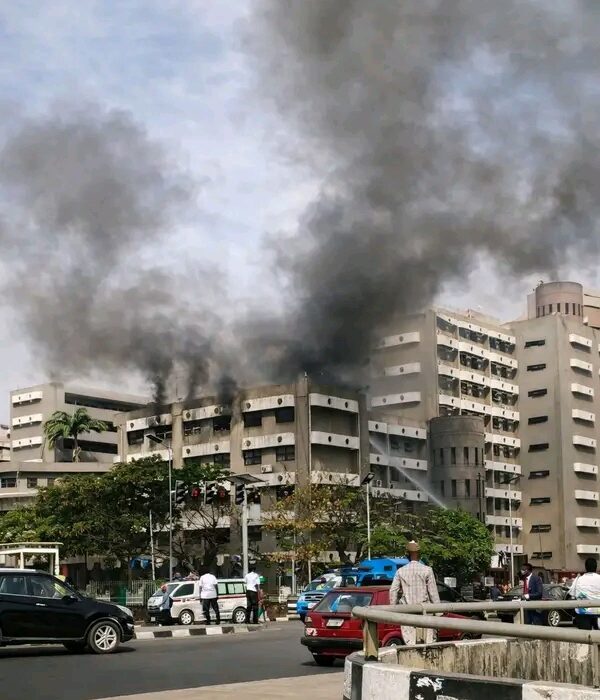
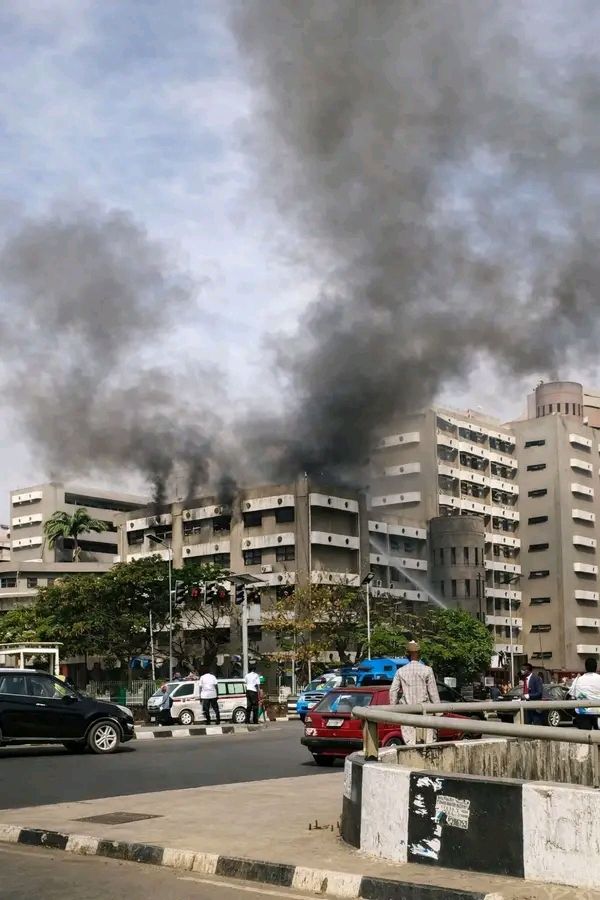
Panic gripped workers at the Federal Secretariat on Monday morning, March 9, 2026, after a fresh fire outbreak engulfed a section of the Head of Service of the Federation building, marking yet another chapter in a troubling pattern of recurring infernos at the same complex .
The fire was first noticed around 8:20 a.m. in Section C of the building, with thick smoke billowing from the affected area as staff scrambled to evacuate . Emergency responders were swiftly deployed to contain the situation, while workers moved to safety away from the blazing section.
Officials at the Media Department of the Office of the Head of Service of the Federation confirmed the incident, stating that the fire outbreak is “limited to Section C of the building” and is currently being attended to by emergency officials . The exact cause of the fire has yet to be determined, as investigations are expected to commence once the situation is fully brought under control .
Monday’s incident is far from isolated. The Federal Secretariat complex has experienced multiple fire outbreaks over recent years, raising serious questions about the effectiveness of safety protocols and maintenance standards at one of Nigeria’s most critical government facilities.
In October 2021, the complex witnessed two separate fire incidents in a single day. The first, occurring around 5:00 p.m. , saw an 18-seater Coaster bus engulfed in flames at a parking lot within the secretariat . The FCT Fire Service confirmed the bus was completely destroyed but managed to prevent the fire from spreading to nearby buildings .
Hours later, at approximately 8:00 p.m. , a more serious fire gutted the Federal Ministry of Education area of the secretariat. The blaze affected the second floor, destroying records in the registry, accounts, pension, and variation units . One unidentified individual sustained a leg injury during the incident .
Authorities at the time suggested the fire was “likely from a split air conditioner,” though investigations continued .
Two years later, on December 2, 2023, another significant fire broke out at Block C of Phase II of the Federal Secretariat. The building housed the Office of the Special Adviser to President Bola Tinubu on Sustainable Development Goals (SDGs) .
The fire, which began around 2:30 p.m. , was triggered by “an explosion from the Electrical Utility Room” on the third floor, which was being used as a solar and inverter room by the occupant . The blaze spread through utility rooms from the second to the eighth floors before firefighters from both the Federal and FCT Fire Services brought it under control by 5:00 p.m. .
Permanent Secretaries and senior officials were present on the ground as the operation lasted .
The recurring nature of these incidents has drawn attention to longstanding warnings about fire safety in public buildings.
Years before the recent spate of fires, authorities had already raised alarms. The Controller-General of the Federal Fire Service had previously warned that “many government structures here (Abuja) need to be sanctioned because the lives of people working there are not safe” . The agency cautioned that non-compliance with fire safety requirements made numerous public buildings unsafe for workers, threatening to close down facilities that failed to install necessary fire-fighting requirements .
In mid-2024, AbdulGaniyu Jaji, then Controller-General of the Federal Fire Service, reiterated that all public buildings must adhere to the fire safety code or face sanctions . Speaking at the inauguration of a committee on curriculum development, Jaji referenced recent fires at Karu Market in Abuja, the Dangote refinery, and a Christ Embassy Church in Lagos, noting that efforts were underway to review the 1964 law establishing the FFS to empower the service to properly sanction defaulters .
Just five months before Monday’s fire, the Federal Government appeared to acknowledge the gravity of the situation. In October 2025, alarmed by “the rising spate of fire outbreaks in major cities,” the government inaugurated a Special Task Force on Public and Private Building Audit to enforce stricter compliance with fire safety regulations nationwide .
Controller General Olumode Adeyemi Samuel, who performed the inauguration, stated plainly: “The frequency of these incidents underscores the urgency of enforcing safety standards. Fire safety is not a choice but a shared responsibility” .
The Task Force was charged with immediately mapping public buildings across the country, classifying them by risk levels, inspecting compliance, and submitting actionable recommendations .
The recurrence of fire outbreaks at the same complex, despite repeated warnings and promises of action, strongly suggests systemic failures in safety management.
Recurring electrical causes: The December 2023 incident was directly linked to an electrical utility room being used improperly for solar equipment . Electrical faults appear as a common thread across multiple incidents, pointing to potential deficiencies in the building’s electrical infrastructure and its maintenance.
Failure to learn from past incidents: With at least four publicly reported fire outbreaks at the Federal Secretariat complex since 2021, questions arise about whether comprehensive safety audits and preventive measures were ever implemented after previous fires.
Gap between promises and action: Despite the October 2025 announcement of a nationwide building audit and warnings about sanctions dating back years, Monday’s fire demonstrates that vulnerabilities remain unaddressed at one of Nigeria’s most important government complexes.
As authorities begin investigating the latest incident, many will be watching to see whether this fire finally prompts concrete action — or becomes merely another entry in a growing list of near-misses at the Federal Secretariat.
Additional details about the March 9, 2026 fire are expected from officials as investigations proceed .