

Senate Rejects New Fintech Regulator, Hands Oversight to CBN
By Momodu Favour
The Nigerian Senate has rejected proposals to establish a new regulatory body for the country’s rapidly expanding financial technology sector, opting instead to strengthen the supervisory powers of the Central Bank of Nigeria.
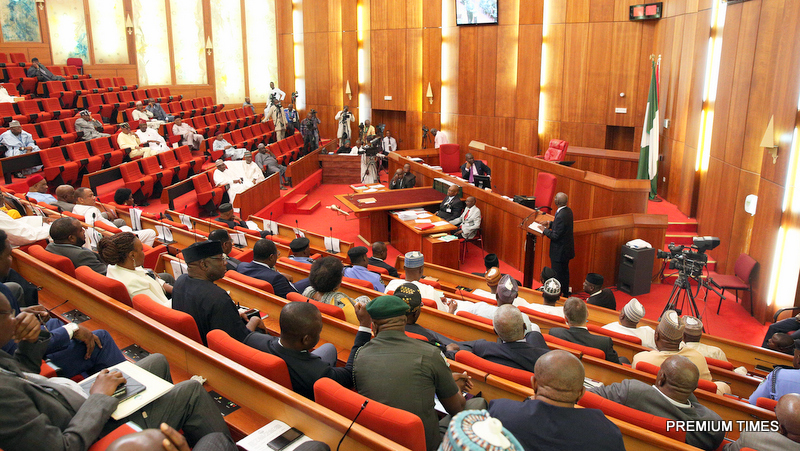
The decision was announced on Wednesday during a one-day public hearing at the National Assembly in Abuja, where lawmakers also called for tougher action against the growing wave of Ponzi schemes operating across the country.
Chairman of the Senate Committee on Banking, Insurance and Other Financial Institutions, Mukhail Adetokunbo Abiru, disclosed the position while speaking at the hearing.
The session focused on the proposed amendment to the Banks and Other Financial Institutions Act, through the Banks and Other Financial Institutions Act (Amendment) Bill, 2025 (SB. 959), as well as an investigative review of Ponzi scheme operations in Nigeria, with particular attention to the recent Crypto Bullion Exchange incident.
The hearing was jointly organised by the Senate Committees on Banking, ICT and Cyber Security, Capital Market, and Anti-Corruption and Financial Crimes.
Abiru said the proposed amendment is aimed at strengthening the legal framework under the Banks and Other Financial Institutions Act, 2020, and providing a statutory basis for the designation, registration and supervision of Systemically Important Institutions, particularly technology-driven financial service providers.
He explained that the amendment seeks to reflect the realities of Nigeria’s evolving financial ecosystem, where fintech companies now handle massive transaction volumes and store sensitive financial data belonging to millions of Nigerians.
Over the past decade, fintech firms including mobile money operators, payment platforms, digital lenders and settlement companies have grown rapidly, helping to expand financial inclusion. However, lawmakers noted that regulation has not kept pace with the scale and influence of these companies.
Although the Central Bank of Nigeria currently designates Systemically Important Financial Institutions, the existing framework largely focuses on banks and does not fully address large non-bank digital platforms, thereby creating regulatory gaps.
Abiru said the amendment would empower the apex bank to designate qualifying fintech companies and digital financial institutions as Systemically Important Institutions.
It would also establish a national registry to enhance transparency and beneficial ownership disclosure, strengthen risk-based supervision tailored to technology-driven services, and promote data sovereignty and systemic stability.
According to him, creating a separate regulatory agency for fintech would only complicate oversight.
“The question has arisen as to whether the creation of a new standalone regulatory agency would be a preferable pathway for supervising fintechs.
However, after careful consideration, it is evident that establishing an entirely new agency would duplicate functions, create bureaucratic overlap, increase administrative costs, and fragment regulatory authority in a sector where coordination and coherence are essential,” he said.
Abiru noted that fintech regulation is closely linked to monetary policy, payment system oversight, prudential supervision, Know-Your-Customer requirements and anti-money laundering enforcement all of which are responsibilities already handled by the Central Bank of Nigeria.
He added that strengthening the BOFIA framework would also ensure stronger coordination between the CBN and other regulatory bodies such as the Securities and Exchange Commission, Nigerian Communications Commission, National Information Technology Development Agency, Corporate Affairs Commission, Federal Competition and Consumer Protection Commission, the Office of the National Security Adviser and the Federal Ministry of Finance.
Beyond fintech regulation, the Senate also intensified scrutiny of fraudulent digital investment platforms and Ponzi schemes.
Abiru described the rising prevalence of such schemes as a serious threat to financial stability and public confidence in the financial system. He cited the recent Crypto Bullion Exchange case, which reportedly resulted in significant financial losses for many Nigerians.
According to him, victims of the scheme included young professionals, retirees, traders, small business owners and students.
He warned that Ponzi schemes not only cause personal financial hardship but also erode trust in legitimate financial institutions, distort capital allocation, damage Nigeria’s financial reputation and increase the risk of money laundering and illicit financial flows.
Following its investigation into regulatory gaps, institutional coordination and the adequacy of existing laws, the Senate said it would introduce stricter regulatory measures to curb fraudulent investment platforms.
Stakeholders who presented submissions at the hearing included representatives of the Central Bank of Nigeria, Nigerian Deposit Insurance Corporation, Economic and Financial Crimes Commission, Nigerian Communications Commission, Federal Competition and Consumer Protection Commission, the Ministry of Finance Incorporated and the Chartered Institute of Bankers of Nigeria.
The Senate said it would review the memoranda submitted by stakeholders before making its final recommendations on the proposed amendment and other regulatory reforms.