

FG’s ₦501 Billion Power Sector Bond Records 100% Subscription
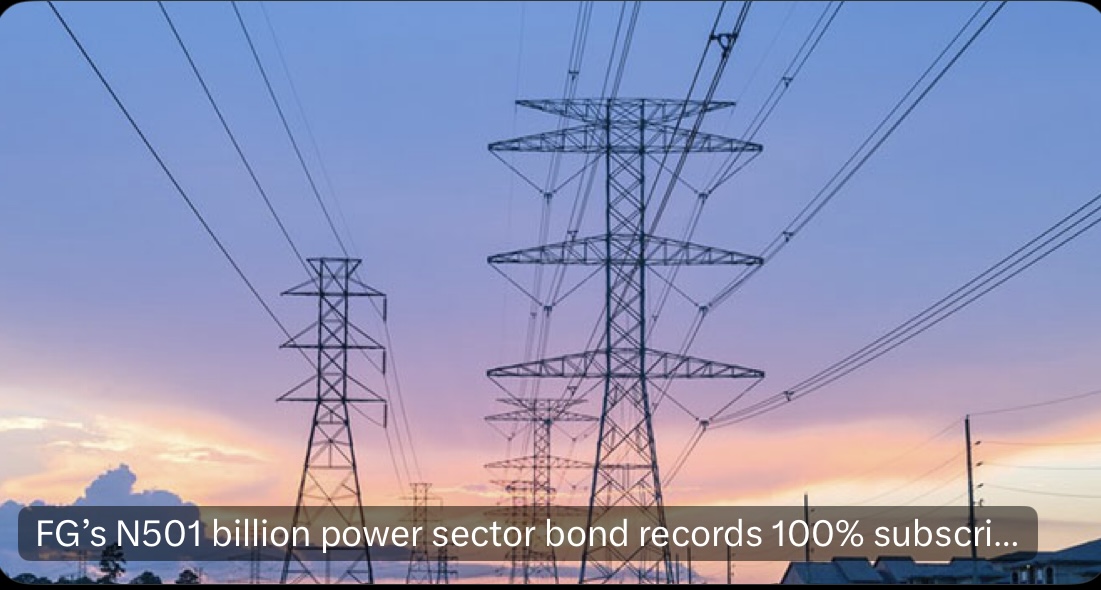
In a landmark show of investor confidence, the Federal Government of Nigeria’s inaugural ₦501 billion power sector bond has been fully subscribed, attracting strong interest from pension funds, banks, asset managers, and other institutional investors.
The bond, issued under the Presidential Power Sector Debt Reduction Programme (PPSDRP), aims to tackle long-standing financial liabilities in Nigeria’s electricity sector, which have hindered operations and investment for over a decade. Proceeds from the bond will be used to settle verified debts owed to power generation companies (GenCos), thereby restoring liquidity across the power value chain and strengthening payment certainty to gas suppliers and other sector players. The issuance was structured in two tranches: ₦300 billion raised from the capital markets and ₦201 billion allocated directly to participating GenCos, demonstrating both market appetite and industry alignment. So far, five GenCos representing 14 power plants, including First Independent Power Limited, Geregu Power Plc, Ibom Power, Mabon, and the Niger Delta Power Holding Company, have signed formal settlement agreements. Government officials emphasized that the bond is not a bailout but a strategic reset designed to bolster the financial foundation of the power sector, attract fresh investment, and improve electricity supply reliability. The programme also aligns with the Federal Government’s broader multi-instrument initiative aimed at systematically addressing legacy power debts estimated at over N4 trillion. Special Adviser to the President on Energy, Mrs. Olu Arowolo Verheijen, noted that disciplined implementation and transparent capital market financing are key to the programme’s success. Analysts believe that clearing these legacy debts could unlock capacity improvements, enhance maintenance of power plants, and ultimately improve electricity supply — a critical step toward supporting industrial growth and everyday power reliability for Nigerians.