
States Write Big 2026 Budgets on Uncertain Revenue as Federal Allocations Remain the Lifeline
As governors across the country roll out expansive 2026 budgets promising roads, schools, hospitals, and economic growth, the numbers beneath the proposals tell a more cautious story: most states are still spending far beyond what they earn locally, tying their development plans to Abuja, loans, and other uncertain inflows.
A review of appropriation bills and approved estimates shows that internally generated revenue remains too weak in many states to meaningfully support either recurrent obligations or ambitious capital programmes.
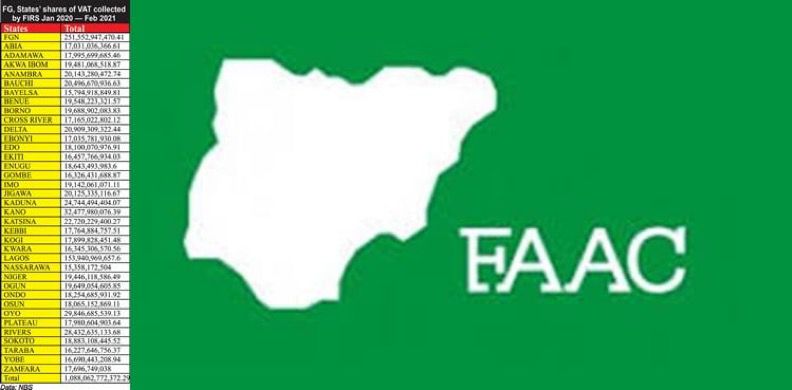
Instead, federally shared revenue from the Federation Accounts Allocation Committee continues to serve as the backbone of subnational finance, supported by VAT distributions and, in oil-producing states, derivation proceeds.
The pattern underscores how deeply states remain fiscally dependent on the centre. In many cases, guaranteed income from IGR can barely cover salaries and overheads, leaving capital spending to be funded by federal transfers, grants, borrowing, and other one-off receipts whose timing and size are not fully within state control.
Lagos State, often cited as the benchmark for revenue generation, illustrates both the possibilities and limits of subnational finance.
The state plans to spend N4.237tn in 2026, the largest budget ever proposed by a state government.
Governor Babajide Sanwo-Olu said the proposal, aligned with his administration’s T.H.E.M.E.S.+ agenda, will draw N3.12tn from IGR and federal transfers, while bonds and loans will make up the balance. Despite Lagos’ strong tax base, debt remains necessary to close the funding gap.
For smaller states, the strain is more visible.
Abia State’s proposed N1.016tn budget heavily favours capital expenditure, which accounts for 80 per cent of total spending.
However, projected revenue of N607.2bn leaves a deficit of about N409bn, nearly 40 per cent of the budget. While the state expects IGR to cover recurrent costs, its capital ambitions rest largely on federal allocations, grants, and borrowing.
Ogun State’s N1.669tn “Budget of Sustainable Legacy” follows a similar structure. Although the state projects N509.88bn from IGR, more than 30 per cent of its funding is expected to come from capital receipts, including internal and external loans and grants.
Analysts note that such sources are non-recurring and expose budget execution to financing risks.
Enugu State’s N1.62tn budget, a 66.5 per cent increase over 2025, also reflects this dependence. While the state projects a strong N870bn in IGR, about 20 per cent of planned spending relies on loans and grants, signalling continued reliance on external financing to deliver its development agenda.
The Managing Director of Optimus by Afrinvest, Dr Ayodeji Ebo, warned that this funding model carries long-term risks.
“These revenues are volatile and largely outside state control, making budgets vulnerable to oil price shocks. Over time, this approach also discourages ingenuity, as states become dependent on external inflows rather than building durable local revenue sources,” he said.
In Osun State, the N723.45bn budget balances projected inflows with spending, but a sizeable portion of revenue is expected from capital receipts, which are not guaranteed.
Delta State, buoyed by expectations of higher federal inflows following fuel subsidy removal, plans to spend N1.664tn, with 70 per cent allocated to capital projects. Despite efforts to improve revenue collection, the state remains heavily reliant on oil-linked transfers.
The dependence is even sharper in Sokoto and Bayelsa States. Sokoto expects less than 10 per cent of its N758.7bn budget to come from IGR, relying instead on FAAC allocations and donor funding. Bayelsa’s N1.01tn budget similarly draws under 10 per cent from IGR, with the bulk coming from derivation revenue, FAAC allocations, loans, and grants.
Edo State’s N939.85bn budget reflects a mix of FAAC allocations, grants, and public-private partnerships, while Gombe and Kwara States base their projections on capital receipts and favourable macroeconomic assumptions, including oil prices and exchange rates. Analysts warn that any deviation from these assumptions could delay or derail capital projects.
Fiscal expert Aliyu Ilias said the current structure of subnational finance continues to place pressure on the federation.
He argued that without stronger incentives to grow IGR, states will remain dependent on Abuja.
He proposed “counterpart funding,” where states that increase their IGR receive proportional benefits, adding that despite record FAAC disbursements, improved living standards have not automatically followed.
Ilias also urged greater emphasis on direct projects at the local government level to ensure funds reach citizens.
Experts maintain that lasting fiscal stability will require states to look inward. According to Ebo, developing comparative advantages in agriculture, manufacturing, tourism, logistics, and services, alongside better infrastructure, land access, and predictable tax policies—will matter more than chasing higher transfers or additional debt.
“Ultimately, fiscal sustainability will come not from higher transfers or more debt, but from productive local economies, broader tax bases, disciplined spending, and smarter collaboration,” he said.
Across the country, analysts note that only a few states have budgets closely aligned with assured revenue, and even these rely heavily on loans and capital receipts.
With salaries and debt servicing taking priority, any revenue shortfall is likely to affect capital projects first.
According to reports that 34 governors have already presented their 2026 budget proposals to their respective Houses of Assembly, while Borno and Rivers States are yet to submit their appropriation bills, highlighting the scale of fiscal ambition, and fragility, across the states as 2026 approaches.